Refugiados: Os campos da Palestina

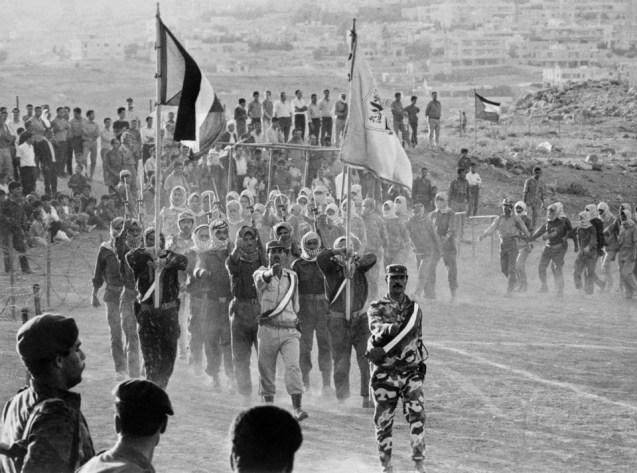
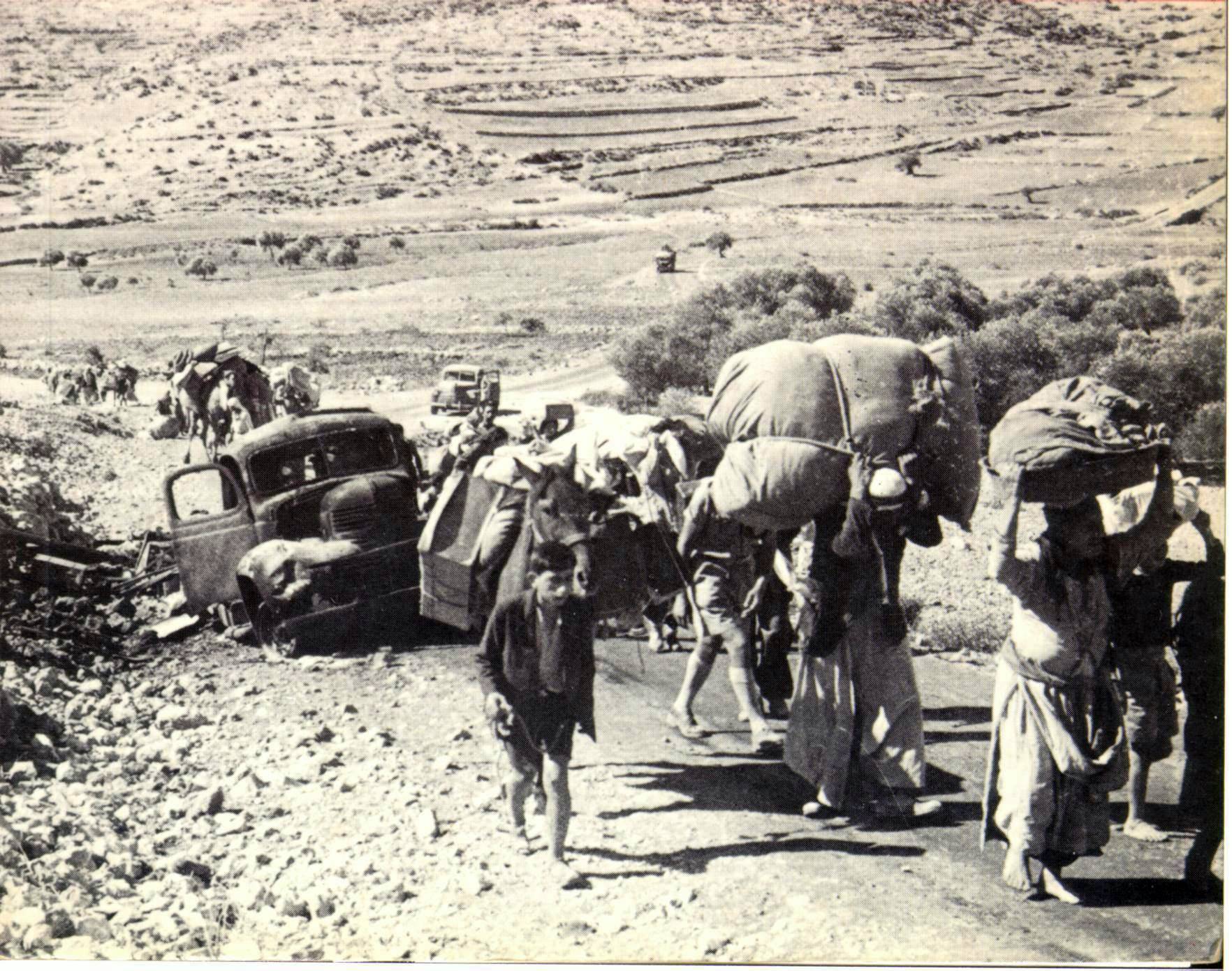
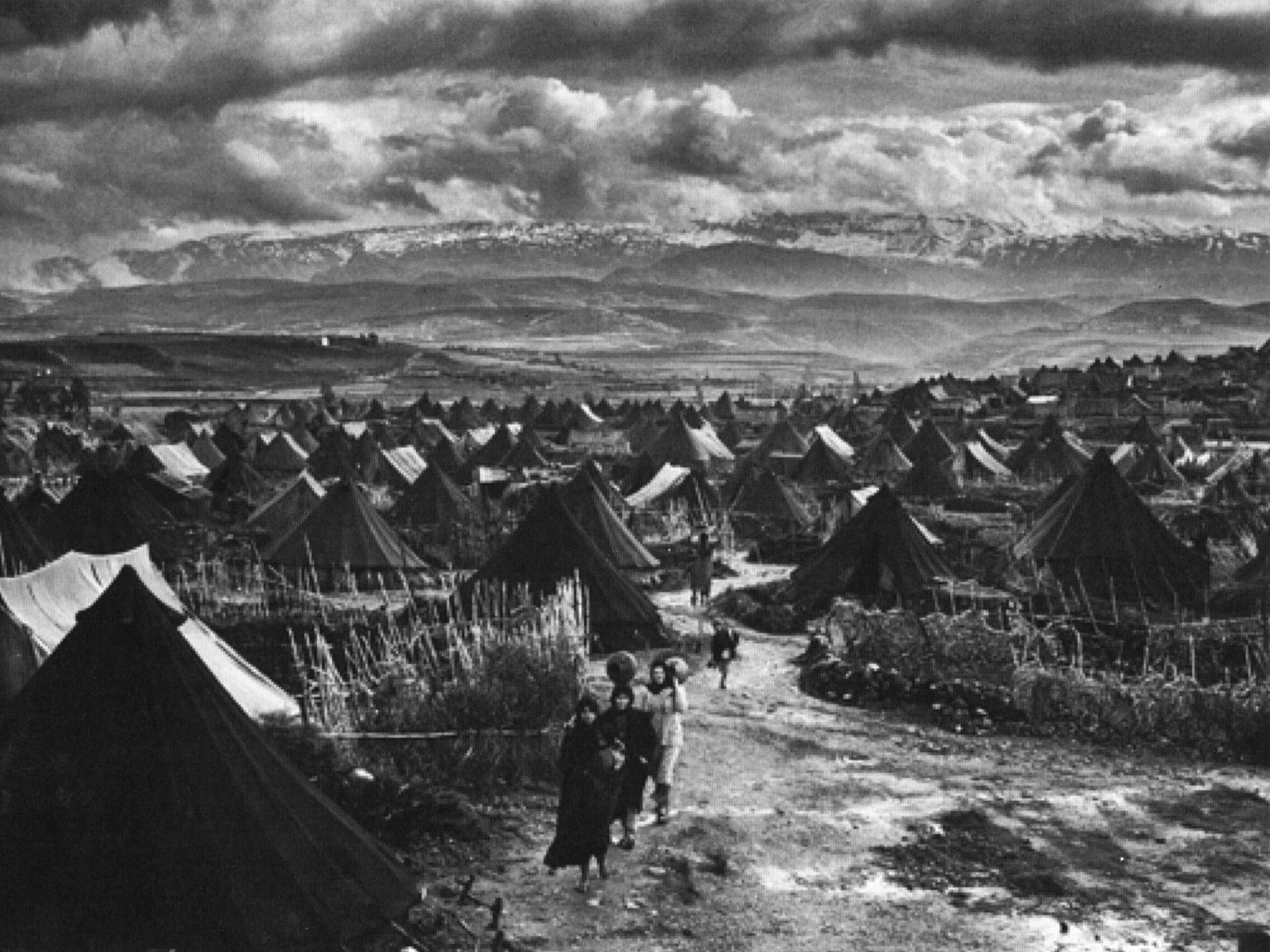
A maior parte dos palestinianos que vivem nos campos de Baqa’a, na Jordânia, e Jaramana, na Síria, partilha a experiência de serem duplamente refugiados, das guerras israelo-árabes de 1948 e 1967. Todos anseiam por regressar à pátria perdida. (Ler mais | Read more…)
© Direitos Reservados | All Rights Reserved

Ilham, 10 anos, tenta explicar a ideia abstracta que tem daquilo a que chama a sua pátria:  “O meu pai disse-me que a Palestina é um sítio muito bonito, com flores, muito melhor do que o campo.”

Ela vive em Jaramana, num campo que alberga mais de oito mil refugiados palestinianos, a cerca de 10 quilómetros de Damasco. Tem os mesmos olhos expressivos das crianças palestinianas que vivem nos campos de Qalandiya, em Jerusalém, ou de Jabalya, na Faixa de Gaza.

Mas o seu ar doce e submisso contrasta com a constante atitude de desafio dos shabab (jovens), que nos territórios ocupados lançam pedras contra os soldados israelitas.

No campo de Baqa’a, a 20 quilómetros de Amã, a maior concentração de refugiados palestinianos de todo o Médio Oriente, com cerca de cem mil residentes [em 1991] – fugitivos das guerras israelo-árabes de 1948 e 1967 e da guerra do Golfo de 1991 -, os rapazes da escola das Nações Unidas olham, tímidos e cabisbaixos, para o grupo de jornalistas que acabou de entrar na sala de aula.

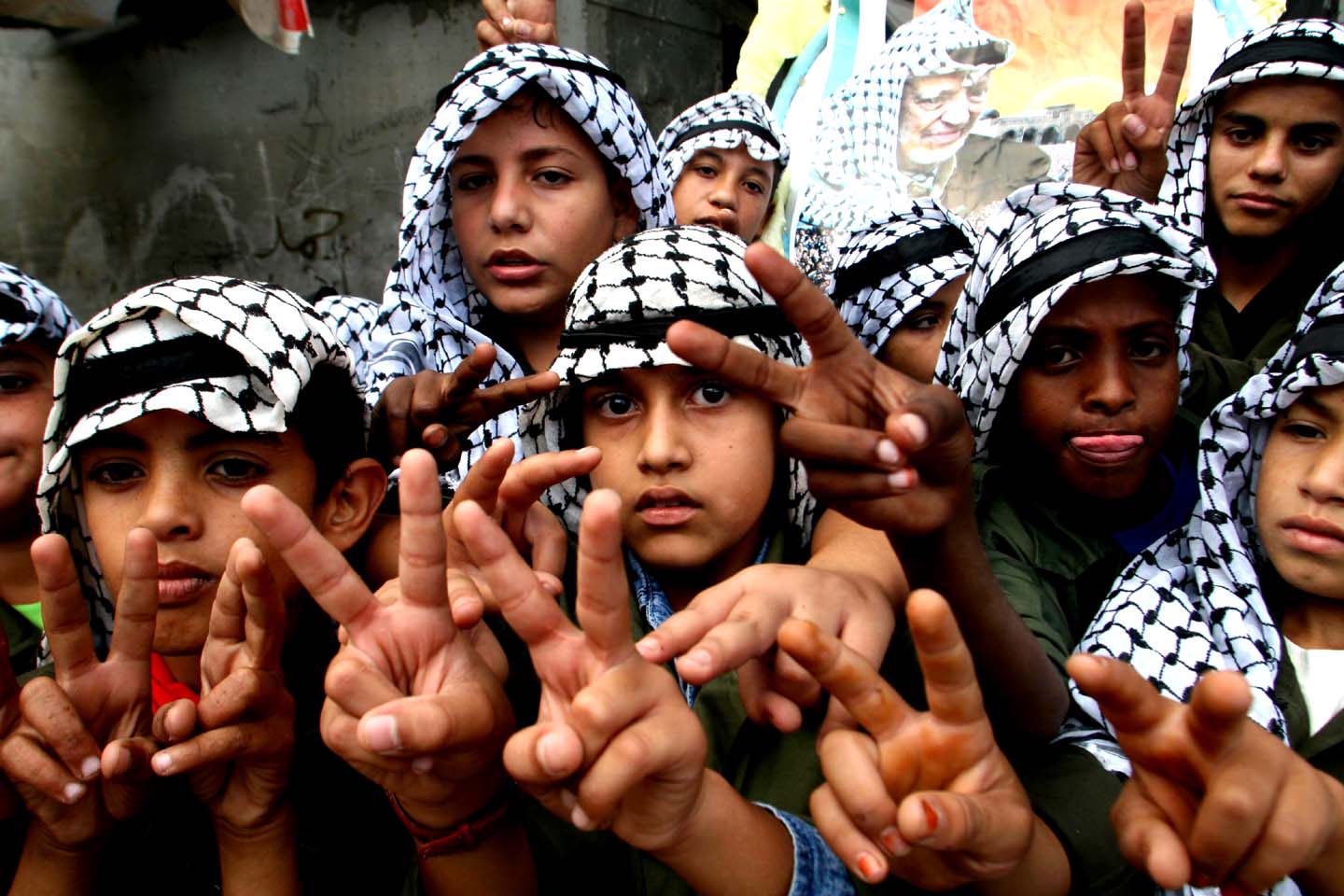
Há dois anos [em 1989], quando visitei Jabalya, o campo que foi o berço da [primeira, 1987-1994] Intifada, em Gaza, os meninos palestinianos faziam com os dedos o sinal de vitória, e exibiam orgulhosos as fundas com que apedrejavam as tropas de ocupação.

Aguerridos, testavam os visitantes cumprimentando-os com a mais famosa saudação hebraica: Shalom [Paz]. As boas-vindas dependiam da resposta, que deveria ser dada preferencialmente em árabe ou inglês.

Apesar de a ocupação os vitimar e desumanizar, os palestinianos da Cisjordânia ou de Gaza mostram-se mais livres do que os seus irmãos confinados aos campos de refugiados espalhados pelo mundo árabe, e que, até à sublevação popular iniciada em Dezembro de 1987, constituíam uma das principais bases de poder da OLP.

É certo que, sob domínio israelita, os palestinianos são cidadãos divididos. A sua mente luta por preservar a identidade palestiniana (quando insistem, por exemplo, em usar camisolas e porta-chaves com os emblemas e cores da Palestina), embora o seu corpo tenha sido “assimilado” por Israel (quando imitam determinados valores do Estado de Israel, constroem colonatos judaicos nos territórios ocupados ou consomem produtos israelitas).

Mas nos campos de refugiados, na Síria ou na Jordânia, eles são prisioneiros de corpo e alma, acomodados a uma situação de miséria e opressão.

© Direitos Reservados | All Rights Reserved

A maioria dos palestinianos na Jordânia, na Síria ou no Líbano é oriunda de povoações como Haifa, Jaffa ou Galileia, que foram integradas nas fronteiras israelitas de 1948. Eles sempre sonharam regressar às suas casas e terras, e, por isso, nunca aceitaram a existência de Israel.

Dos cerca de 1,7 milhões de palestinianos que vivem na Cisjordânia e em Gaza, cerca de um terço também são refugiados de 1948 e vivem em campos, mas a maioria está ligada a famílias com raízes nestes dois territórios. Por isso, o seu problema imediato não é tanto a existência de Israel, mas a ocupação israelita.

Estes palestinianos mostraram-se sempre mais receptivos à solução de dois Estados, porque a convivência com o ocupante lhes mostrou que Israel é demasiado poderoso para ser erradicado.

Forçados a aceitar os conselhos dos palestinianos dos territórios, Yasser Arafat e a OLP reconheceram, em 1988, o direito de Israel existir.

Mas fizeram-no sem dizer explicitamente aos refugiados na Jordânia, Síria e Líbano o que isso significava: que eles já não poderiam regressar às suas casas e às suas terras. O sonho ficou, mas a esperança e vã.

“Nós, aqui, sobrevivemos no desespero. Pelo menos, os que vivem nos territórios ocupados têm oportunidade de lutar”, observou, com voz amargurada, Hana, enfermeira de 21 anos, nascida no campo de Jaramana, onde partilha com os seus dez irmãos uma minúscula habitação.

© Direitos Reservados | All Rights Reserved

Jaramana é, como todos os campos de refugiados, um labirinto de casas degradadas. O odor familiar das especiarias, das frutas e dos vegetais mistura-se no ar com a sensação de opressão.

“Os sírios estão em toda a parte, vigiam-nos, controlam-nos, reprimem-nos”, confessou, num encontro secreto, um palestiniano anónimo.

Não é difícil encontrá-los. Sentado no chão, com as pernas cruzadas, o sírio Ibrahim vende T-shirts, peúgas, saias e calções, com as cores gastas pelo sol.

Diz que é um simples comerciante à procura de cliente certos para a sua mercadoria. “Sabe, eles aqui são pobres e eu vendo barato”, explica-se, com pouca convicção.

O argumento de Hassan Rahmoun, um sírio corpulento que nunca abandona os seus óculos escuros, é ainda mais inverosímil: “Gosto tanto dos palestinianos que decidi viver junto deles”.

Mahmoud Chad, 14 filhos e duas vezes refugiado, acena afirmativamente com a cabeça quando lhe perguntam se a OLP é “o único e legítimo representante do povo palestiniano”.

Então por que não vemos  fotos de Yasser Arafat espalhadas pelo campo, como em Amã, na Cisjordânia ou em Gaza?

Olha em redor, como se receasse ser ouvido, e responde, envergonhado: “Sabe, há pequenas divergências entre grupos, mas as coisas estão a voltar ao normal. É um problema de líderes, não estamos envolvidos nisso”.

Em Jaramana, Arafat e OLP são palavras quase proibidas. Não há fotos do “Presidente do Estado da Palestina”, nem graffiti de saudação ao movimento que ele chefia.

Samantha Fox, a cantora britânica de talento duvidoso e actriz de filmes porno, é a preferida num campo dominado por facções palestinianas pró-sírias, excluídas da OLP e hostis a Arafat.
© Direitos Reservados | All Rights Reserved

Na Síria existem dez campos com um total de 289.923 refugiados registados na UNRWA, a agência de auxílio criada pelas Nações Unidas para socorrer os desalojados e deslocados palestinianos das guerras do Médio Oriente.

Os campos estão sob o controlo da Administração Geral dos Refugiados Palestinianos Árabes, uma organização criada pelo Governo sírio em 1949.

Os seus membros são nomeados por decreto presidencial, e os salários que recebem provêm de verbas previstas no orçamento de Estado sírio. Dos dez membros da Administração, apenas três são palestinianos.

“O Governo sírio trata os palestinianos como se fossem cidadãos sírios. Não há discriminação”, declarou Mohammed Abu Zarad, o director.

É uma estranha maneira de apresentar a situação, sobretudo se recordarmos uma frase do [anterior] Presidente sírio, Hafez al-Assad, pronunciada em Abril de 1976, e que provocou calafrios a muitos palestinianos.

“Não existe um povo palestiniano”, frisou o senhor de Damasco, sempre defensor da “unidade da nação árabe” sob o domínio da “Grande-Síria”.

Também Golda Meir, a falecida primeira-ministra de Israel, dizia que “não existe essa coisa a que chamam palestinianos”.

Os palestinianos de Jaramana vieram na sua maioria dos Montes Golã, território sírio que os israelitas conquistaram em 1967 e anexaram em 1981. Nos Golã, alguns já eram refugiados da guerra de 1948. As suas antigas aldeias fazem agora parte do Estado de Israel.

“Nasci nos Montes Golã, mas sou palestiniano”,  diz, num misto de orgulho e revolta, Mahmoun Aburaas, 32 anos, funcionário público em Damasco, residente em Jaramana.

“A minha família era uma das mais antigas e mais importantes em Gaza. Fomos dispersos pelos franceses, pelos ingleses e pelos israelitas”,

Como que contagiados pelas queixas de uns e outros, os palestinianos não se calam. “Os meus pais são refugiados de 1948. Viviam em Safed [actualmente território israelita]. Perdemos o contacto com a nossa família. A nossa vida aqui é muito triste. As crianças ficam na escola alguns meses, e depois abandonam as aulas. Vendem cigarros para sobreviver”, relata a jovem Hana.

© Direitos Reservados | All Rights Reserved

Os habitantes dos campos respondem, ansiosos, a todas as perguntas. Mas, quando chega o momento de interpelar os jornalistas, as suas questões, colocadas friamente, tornam-se embaraçosas. Ávidos por respostas esclarecedoras, também eles emudecem perante o silêncio dos seus interlocutores.

“Há 50 anos que recebemos missões e nada mudou”, queixa-se Masri, de 74 anos, refugiado de 1948 e 1967.

Ele grita, gesticula, lamenta-se sem uma pausa no seu azedo discurso: “Estamos cansados. Será que ainda não perceberam o que se passa? O que é preciso mais? Até o Vietname que era um problema insolúvel foi resolvido. Se a América quisesse devolver-nos a nossa pátria, podia fazê-lo em cinco minutos.”

No cubículo onde come e dorme, em Jaramana, longe dos olhares dos sírios que tudo vigiam, o velho refugiado não resiste a contar a sua história: “Na Palestina, eu era agricultor. Os judeus confiscaram as minhas propriedades. Fingiram que nos compraram as terras, mas eu ainda tenho os registos a comprovar que sou o dono.”

Tal como Masri, Hajji Atta al-Whidi ainda guarda as chaves da sua casa numa aldeia da Palestina que hoje faz parte do Estado de Israel.

O seu primeiro nome revela que já foi a Meca, em cumprimento do último mandamento do Islão [Haj significa peregrinação e Hajji peregrino].

O chefe do Comité de Serviços do campo de Baqa’a é um muçulmano convicto:  Nós regemo-nos por três princípios morais: terra, honra e [laços de] sangue.”

“A terra está sempre em primeiro lugar e seria uma grave injustiça e um crime se me privassem do direito de ser repatriado”, frisou Whidi, um refugiado da guerra de 1948, que reclama o direito de retorno previsto na Resolução 194 da ONU. “É um direito humano!”,

© Direitos Reservados | All Rights Reserved

© The Palestinian Museum

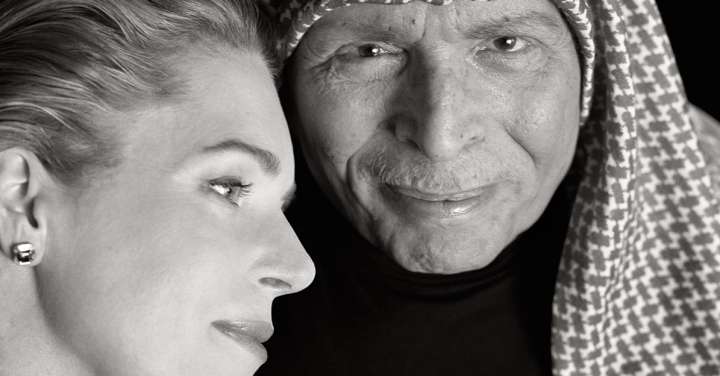
Envergando uma longa túnica e uma capa sobre os ombros, com o kaffiyeh a cobrir a cabeça e dedilhando um fio de contas, ele tem um porte altivo, que evoca o mago Merlin da corte do Rei Artur.

É o notável do campo, o sábio que arbitra as disputas e resolve os problemas comunitários. As suas palavras, ouvidas em silêncio, são entremeadas com provérbios árabes.  Os direitos nunca serão perdidos, se forem sempre exigidos.”

Mohammed Al-Nuseirat, um engenheiro que também pertence ao Comité de Serviços, faz uma declaração reveladora do desespero que caracteriza a vida dos refugiados: “Queremos regressar às nossas terras e às nossas casas, mesmo sob um regime político israelita. Estou convencido de que, no futuro, não haverá fronteiras a separar a Palestina, Israel e a Jordânia. Haverá liberdade de movimentos para todas as pessoas.”

Baqa’a é o maior campo de refugiados do Médio Oriente, com cem mil pessoas vivendo numa área de 1,8 quilómetros quadrados.

É um misto de aldeia rural e vial suburbana, com carrinhos de venda de fruta e vegetais, livrarias, farmácias, lojas de electrodomésticos, aviários, talhos e peixarias, e até um banco e um clube de vídeo.

Há escolas construídas com a ajuda de governos estrangeiros e uma clínica onde seis médicos e 18 enfermeiras atendem 600 pacientes por dia, para tratar desde uma simples ferida até à doença mais frequente: depressões nervosas.

A construção desleixada das casas sugere que elas deveriam ser provisórias, mas na realidade tornaram-se definitivas.

“O mais triste é que os refugiados se habituaram a esta situação de miséria e nada fazem para mudar a sua condição de gente pobre”, lamentou o holandês Franke de Jonge, director da UNRWA em Amã.

“Os campos são o sítio mais barato para se viver. Oficialmente, os refugiados não deviam pagar renda, mas pagam. E, quando alguém se muda para fora do campo, logo outro ocupa o seu lugar, geralmente da mesma família.”

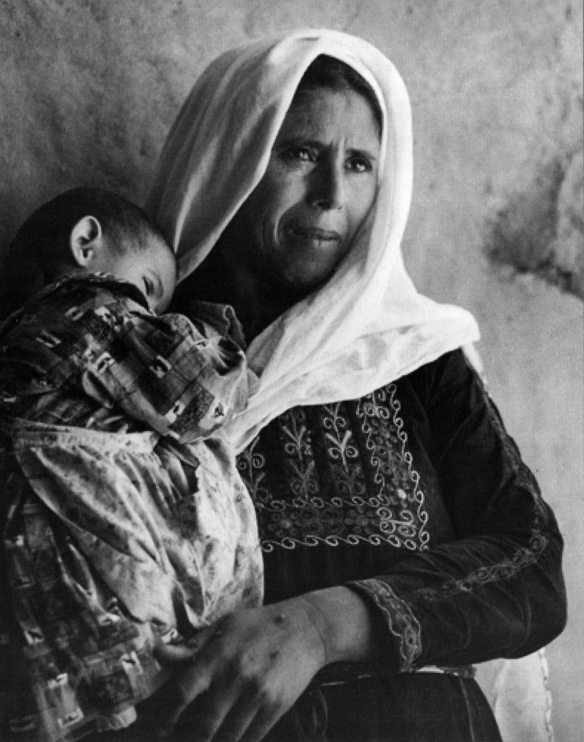
Ahmad Mahmoud Hossein Jaber é o perfeito exemplo de uma vida de resignação. Aos 72 anos, este agricultor oriundo de Rafah, no sul da Faixa de Gaza, refugiado da guerra de 1948, partilha dois quartos e uma cozinha, em Baqa’a, com as suas duas mulheres e uma filha viúva.

As paredes são húmidas e gélidas no Inverno. No Verão, o calor é sufocante. O contraplacado do tecto está tão retorcido que parece que vai desabar a qualquer momento.

As janelas são tão pequenas que parecem postigos. O chão de betão está cheio de gretas. Durante o dia, o quarto de Jaber parece espaçoso. Os colchões rotos e gastos foram arrumados a um canto, na vertical.

No exíguo compartimento onde prepara as refeições, o intenso cheiro de querosene do candeeiro e de gás do fogão faz recear uma explosão iminente.

No meio de tanta miséria, o velho palestiniano ainda consegue sorrir.
© Direitos Reservados | All Rights Reserved

Este artigo, agora revisto e actualizado, foi publicado originalmente no jornal PÚBLICO em 22 Novembro de 1991 | This article, now revised and updated, was originally published in the Portuguese newspaper PÚBLICO on November 22, 1991
The Lion of Damascus and the Star of David

In Damascus, Israel has disappeared from the maps of Palestine. It is difficult to foresee what kind of relations these two major Middle East antagonists will be able to establish if the conflict is ever settled. The United States was also an enemy, and now it seems to be a saviour.  (Read more…)

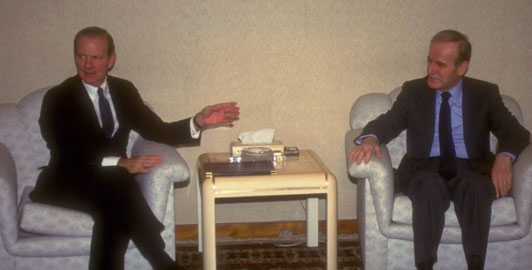
James Baker (left), George HW Bush’s Secretary of State, managed to convince then Syrian President Hafez al-Assad to send a delegation to the Madrid Conference in 1991
© jamesbaker.thinkport.org

If, after more than 40 years [in 1991] of hostility, distrust and suspicion, a settlement of the Israeli-Arab conflict were to be reached, what kind of relations would Syria be prepared to establish with State that defines itself as Jewish?

Nasser Kaddour, State Minister of Foreign Affairs, did not hesitate for a second when I made this question. It was if he knew in advance what to reply, and the answer was extremely short: “Syria accepts all provisions and consequences of United Nations Resolution 242. It is not appropriate to exceed the limits before everything has been defined.”

The second most important man of Damascus diplomacy [after Farouk al-Sharaa, who was Foreign Minister from 1984 until 2006, when he became Vice-President] was speaking during a meeting, in his office, in the Syrian capital, with European journalists invited by the United Nations.

In a country where the maps of Palestine remain unchanged, as if Israel does not exist since 1948, where the neighbor country is presented as the most sinister of enemies, where children wear military uniforms in schools where they learn to hate the “Zionist entity”, it is difficult to foresee how and when these two enemies will be able to maintain normal relations.

Some analysts admit a future cooperation at a regional level; others anticipate a kind of “cold peace” which has defined the links between Egypt and Israel; and there are others who evoke the possible replacement of the current “state of war” by a “state of non-belligerence”.

Kaddour insists that Israel must accept the principle of “land for peace” before its recognition, and his demand makes sense. Israel has not yet accepted the United Nations Resolution 242 – a number that is certainly a magic formula here, in Damascus.

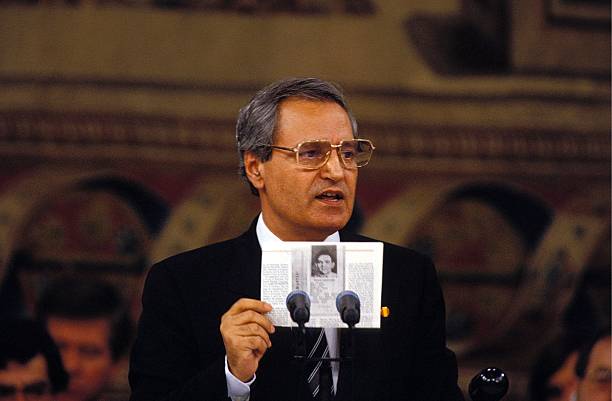
Farouk al-Sharaa, the former Syrian Foreign Affairs Ministers in the Madrid Peace Conference of 1991. He caused an uproar when he exhibited a picture showing the then Israeli Prime Minister, Yitzhak Shamir, when he was on a wanted terrorist list of the British Mandate authorities of Palestine. @All Rights Reserved

Farouk al-Sharaa, then Syrian Foreign Affairs Minister, in the Madrid Peace Conference. He caused an uproar when he exhibited a paper showing a photo of Israeli Prime Minister, Yitzhak Shamir, in a list of terrorists that the British Mandate authorities wanted to capture in Palestine

All that Syria can give or refuse in the peace process is in the 242 Resolution, the one that deliberate as inadmissible the occupation of territories by force and that affirms the right of every State in the region to live within secure borders.

“If Israel wishes to have peace, and if the Arabs want Syria to participate in multilateral talks, it is fitting that the Israelis should first make a commitment regarding Resolution 242, or agree to withdraw from he occupied territories, recognizing the legitimate rights of the Palestinian people”, Kaddour said.

According to chief diplomat in Damascus, “a promise from Israel is sufficient – together with guarantees from the United States and the USSR  – for Syria to move ahead with the peace process”.

Unless Israel makes a clear commitment, Kaddour warned, “Syria will not participate I multilateral talks even if other Arab parties decide to do so.” In his view, it makes no sense for a country to discuss economic aid and ecological issues if its territory remained occupied.

“What point is there for the Arabs to discuss regional problems if there is no defined geography, if borders are not demarcated?” This was a question previously raised by Mohammed Saleman, the Syrian Minister of Information.

All Syrian officials use the same words, the same slogans and the same clichés. No one can conjecture what lies behind such “esoteric” language.

1987: A Syrian army checkpoint in front of the Commodore Hotel in Beirut. In 1991, the United States did not oppose Syria’s influence in Lebanon and so President Hafez al-Assad agreed to participate in the Madrid Conference
© Kamel Lamaa | AFP | Getty Images | timeline.com

If Israel remains uncompromising, will the Syrians carry on the bilateral talks? “Well, everything depends on the Americans”, Kaddour said, confidant that like all his other governmental colleagues that the United States will aplly tremendous pressure on Israel to bring to an end the task which it began.

“The Present American Administration [of President George H. W. Bush] has a serious and genuine interest in bringing peace to the region; that was the reason for our favorable response to the United States initiative”, the Syrian Minister remarked.

[Syria accepted the invitation to be present in the 1991 October Madrid Conference after the US blessed his involvement in Lebanon in exchange for Damascus military participation in the Gulf War that forced Saddam Hussein’s Iraq out of Kuwait, invaded in 1990].

Actually, whereas Resolution 242 seems to be the Bible, or rather the Koran (the majority of Syria population is Muslim), Bush is regarded almost as a god to whom sacrifice must be made but who will ultimately know how to reward the “good guys”.

The “bad” ones are the Israelis who are building settlements in occupied territories and bombarding villages in South Lebanon while proclaiming peace.

That is why Kaddour finds it unfair to speak of extremists among the Palestinians and the Lebanese, because, in his opinion, it is “the aggressive actions” of Israel that encourage the radicals.

nstability in Lebanon has drawn in soldiers from neighbouring Israel and Syria at various points in the country's history. In 1982 Israel invaded Lebanon in a push to destroy the PLO (Palestine Liberation Organization). Israel kept troops in the south until 2000. In 2005 Syria withdrew troops that initially arrived in 1976. @CNN

Instability in Lebanon has drawn in soldiers from neighbouring Israel and Syria at various points in the country’s history. In 1982 Israel invaded Lebanon in a push to destroy the PLO (Palestine Liberation Organisation). Israel kept troops in the south until 2000. In 2005 Syria withdrew troops that initially arrived in 1976
© CNN

So long as Israel occupies the so-called “security belt” in South Lebanon, there will be no peace, the Syrian Minister said. And this is the Syrian and Iran’s position, both being the main poles of influence in Beirut.

Whereas Kaddour assured that Syria is incapable of controlling the Lebanese forces fighting against Israel, the Minister of Information, Mohammed Saleman has a different opinion. He believes that it is possible to sway “the Palestinian extremist elements” opposed to the peace talks, thanks to a recent agreement between Damascus and the PLO.

Some of these radical groups hostile to Yasser Arafat, such as the Popular Front for the Liberation of Palestine – General Command (PFLP-GC), of Ahmed Jibril, or As-Sai’qa, have their headquarters in Damascus. They formed the National Salvation Front, an alliance outside the PLO.

Syria, under Hafez al-Assad, always used the different Palestinian factions one against the other, with the purpose of destroying Yasser Arafat, his main political rival. @All Rights Reserved @Al-Akhbar - Marwan Tahtah)

In refugee camps, like this one in Lebanon, Hafez al-Assad always used different Palestinian factions to fight each other, with the purpose of destroying Yasser Arafat, his main political rival 
© Marwan Tahtah | Al-Akhbar

“Syria has never had problems with the PLO”, said Kaddour (even though it encouraged rebellions, such as the 1984-1989 “War of the Camps” in Lebanon – besieged by the Shi’ite militia Amal; declared Yasser Arafat persona no grata in 1984; and confiscated the assets of the Palestinian National Fund). “The disagreements only involved the several factions of the organization”.

The ongoing reconciliation and coordination efforts with the PLO are part of a Syrian strategy to prevent any Arab delegation from trying to sign a separate peace treaty with Israel, similar to that of Egypt in 1979.

The omnipresent (his picture is everywhere) and almighty (his spies watch every movement) President Hafez al-Assad, know as “The Lion of Damascus, made clear that he can “wait for more than 100 years for the Golan Heights”, lost when he was minister of Defense in the 1967 war.

The Syrians find it difficult to promote their own message. However relevant it might be, it is seldom well received, mainly in the West. In this country there is [in 1991] a great scarcity of communication technicians.

A foreigner arriving in Damascus has beautiful things to appreciate, from a dazzling bazaar to historical monuments, relics of the Ottoman Empire or of the Umayyad Dynasty. He lives in the past, but feels isolated from the real world.

The city has good roads, modern houses (some with no signal of traditional Arab architecture), private schools and clinics, and luxury cars. However, international telephone lines are painfully slow. Only state television is allowed to operate. The local press is censored. Fax machines only exist in ministries, and official statements are pure propaganda.

The Damascus authorities may have to learn, like actors in a play, what I was told in the occupied are of the Golan Heights. It is said that, when they have nothing to do, Israeli soldiers communicate with their Syria counterparts on the other side of the plateau by using Playboy.

They open the magazine at the pages with photos of naked women, and the Syrians apparently enjoy the show with their long-distance binoculars. They thank the enemy by means of signals that both sides understand.

Apparently, what separated them is a psychological wall, so difficult to pass through.

An Israeli soldier stands guard at a checkpoint near the Lebanese-Israeli border, southern Lebanon October 8, 2014
© Baz Ratner | Reuters

This article, now revised and updated, was originally published in the Portuguese newspaper PÚBLICO on November 13, 1991 – the translation, slightly changed here, was published in a UN special edition called “Peace in the News”

O Leão de Damasco e a Estrela de David

Em Damasco, Israel está ausente dos mapas da Palestina. É difícil prever que tipo de relações estes dois antagonistas no Médio Oriente poderão estabelecer se e depois de resolvido o conflito. Os Estados Unidos também eram inimigos e agora aparecem como salvadores. (Ler mais | Read more…)

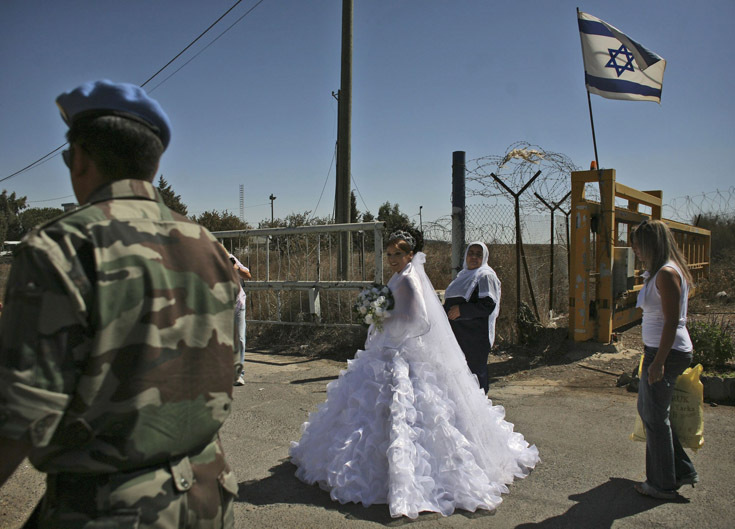
Israeli-Druze bride Arin Safadi, 24, departs through the United Nations buffer zone at the Quneitra crossing in the Golan Heights, which Israel captured from Syria in 1967, to marry a Syrian-Druze groom, Thursday, Sept. 25, 2008. Once crossing into Syria, the bride is not allowed to go back to Israel. Syria and Israel have held four rounds of indirect talks through Turkish mediation so far and Assad recently said he is looking to have direct, face-to-face talks next year. The main sticking point has been the extent of an eventual Israeli withdrawal from the Golan Heights. The issue led to the collapse of U.S.-brokered direct negotiations in 2000. Syria demands the complete return of the Heights. Israel has sought to keep a strip of land around the Sea of Galilee. ©Dan Balilty | AP

Arin Safadi, drusa de cidadania israelita, atravessa a “zona tampão”das Nações Unidas, em Quneitra, na “fronteira” com o restante planalto dos Golã, para  poder casar-se com um druso de nacionalidade síria, em Setembro de 2008. A noiva vivia na aldeia de Ein Qeinya, que Israel conquistou na guerra de 1967, quando Hafez al-Assad era ministro da Defesa. Depois do casamento, não teve autorização de voltar – é assim com todos os que tomam a decisão de se mudar para “o outro lado”
© Dan Balilty | AP

Depois de mais de 40 anos de hostilidades, de desconfiança, de suspeita, se for alcançada uma solução do conflito israelo-árabe, que tipo de relações está a Síria disposta a estabelecer com o Estado de Israel?

Nasser Kaddour, ministro de Estado para os Negócios Estrangeiros, não hesitou um segundo. Era como já soubesse a resposta de cor. Ela foi extraordinariamente breve.

“A Síria aceita todas as cláusulas e as implicações da Resolução 242 da ONU. Não convém ultrapassar os limites antes de tudo ficar definido”, disse Kaddour, o segundo homem mais importante da diplomacia de Damasco, em resposta a uma pergunta que lhe fiz, durante um encontro com jornalistas europeus no seu ministério, no âmbito de uma missão das Nações Unidas.

Num país onde os mapas da Palestina continuam inalteráveis, como se Israel não existisse desde 1948; onde o vizinho Estado de Israel é apresentado como o mais tenebroso dos inimigos; onde as crianças vão à escola de uniforme militar, aprender a odiar a “entidade sionista”, é difícil prever como é que um dia estes dois antagonistas poderão manter relações normais.

Alguns analistas conseguem antever uma espécie de cooperação no futuro a nível regional, outros prevêem uma espécie de “paz fria” que tem caracterizado os laços entre o Egipto e Israel, e há ainda os que prevêem a substituição do actual estado de guerra por um mero estado de não beligerância.

Kaddour insiste em que Israel deve aceitar o princípio “território em troca de paz” antes de ser reconhecido, e a sua exigência faz sentido. Afinal, até hoje, Israel ainda não aceitou a Resolução 242. Este número é, definitivamente, uma fórmula mágica, aqui, em Damasco.

Tudo o que a Síria pode dar ou recusar neste processo de paz está contido na 242, a resolução que considera inadmissível a ocupação de territórios pela força, e que afirma terem todos os Estados da região direito a serem reconhecidos em fronteiras seguras.

O ministro sírio dos Negócios Estrangeiros, Farouk al-Shara, na Conferência  de Madrid, em Outubro de 1991: em resposta à acusação de Yitzhak Shamir de que a Síria “é um Estado terrorista”, Al-Shara rasgou o discurso que havia preparado e exibiu uma velha fotografia do primeiro-ministro israelita distribuída pelas autoridades do Mandato Britânico que o procuravam como “terrorista”, depois do assassínio do Conde Bernadotte, emissário da ONU em 1948. “Ele mata mediadores de paz”, acusou
© Apesteguy | Merillo | N| Simon | Gamma-Rapho via Getty Images

Se Israel quiser ter paz, e se os árabes quiserem que a Síria participe nas conversas multilaterais, é bom que os israelitas assumam primeiro um compromisso em relação à resolução 242, ou seja, que aceitem retirar-se dos territórios ocupados e reconheçam os direitos legítimos do povo palestiniano.

Basta uma promessa de Israel –com as garantias dos EUA e da URSS –e a Síria avançará com o processo de paz, sugeriu Kaddour, a segunda figura do Ministério dos Negócios Estrangeiros de Damasco, depois de Farouk al-Shara [o vice-presidente]. Se Israel não assumir um compromisso claro, então a Síria não participará nas conversações multilaterais, mesmo que as outras partes árabes decidam fazê-lo.

Para Kaddour, não faz sentido um país discutir questões económicas ou ecológicas se o seu território continua ocupado. “O que é que interessa aos árabes discutir problemas regionais, se não há uma geografia definida, se não há fronteiras delineadas?”, interrogara anteriormente o ministro sírio da Informação, Mohammad Salman.

Todos os responsáveis sírios usam a mesma linguagem, os mesmos “slogans”, os mesmos “clichés”. Não se vislumbra o que está para além desta fraseologia tão hermética.

Se Israel se mantiver intransigente durante quanto tempo vão os sírios manter as conversações bilaterais? Bem, tudo depende dos americanos, disse Kaddour, confiante como todos os outros colegas do Governo de que os Estados Unidos vão exercer gigantescas pressões sobre Israel para levar a bom termo a tarefa que começaram.

“A [actual] Administração americana [de George H. W. Bush] tem um interesse sério e verdadeiro em trazer a paz à região, foi por isso que respondemos favoravelmente à iniciativa dos Estados Unidos”, salientou o ministro sírio.

Na verdade, se a Resolução 242 parece ser a Bíblia, ou melhor, o Corão (a Síria é um país maioritariamente muçulmano, embora secular) das autoridades, Bush é visto quase como um Deus, a quem é preciso fazer sacrifícios, mas que no fim saberá recompensar os “bons”.

Os “maus” continuam a ser os Israelitas que constroem colonatos nos territórios ocupados, que bombardeiam aldeias no Sul do Líbano, enquanto apregoam a paz.

É, por isso, que Kaddour acha injusto que se fale de extremistas entre os palestinianos e os libaneses, porque, na sua opinião, são os “actos agressivos” de Israel que fomentam o radicalismo.

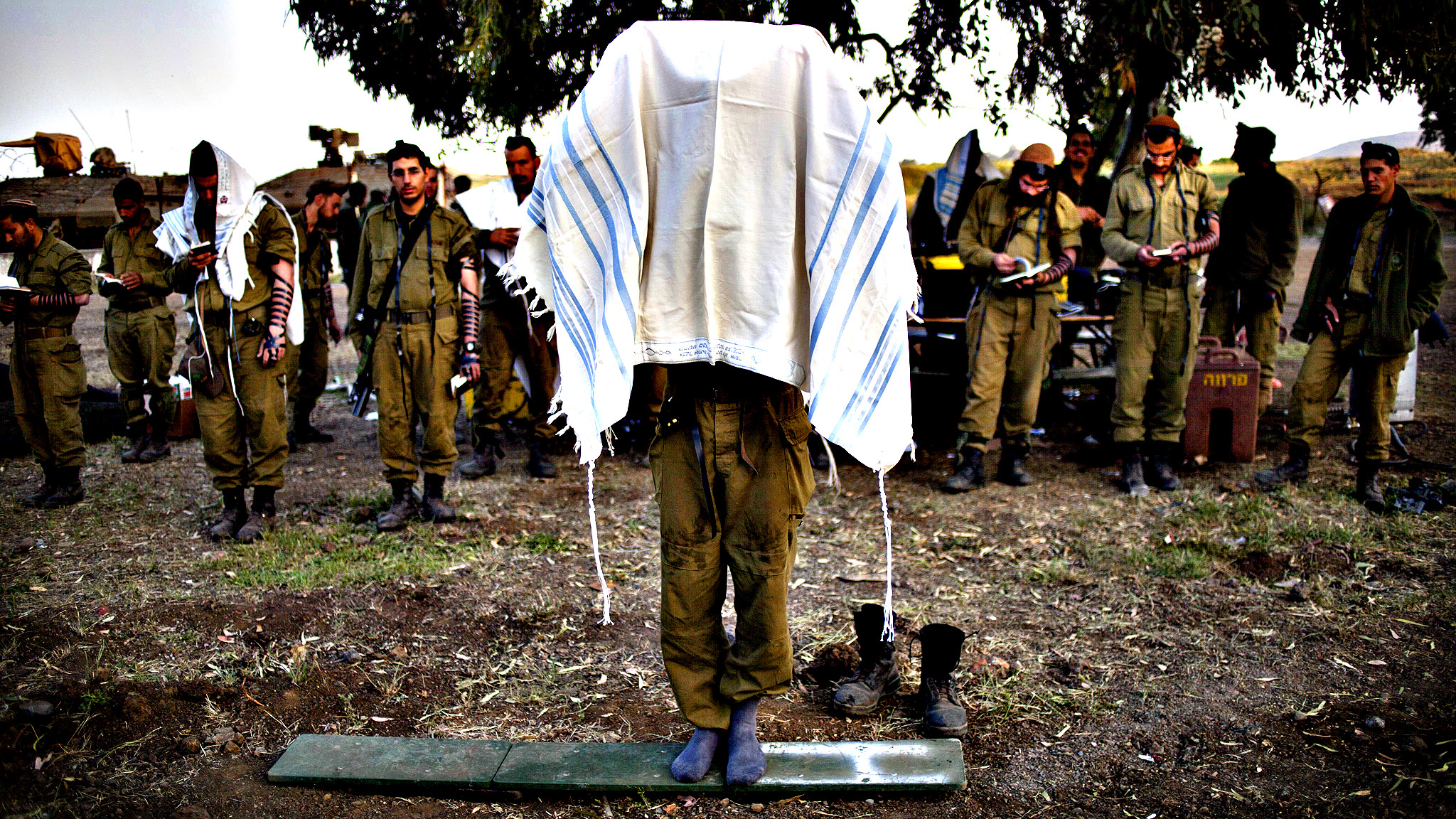
An Israeli soldier of the Golani brigade covers himself in a prayer shawl as others gather for the morning prayer before a military exercise in the Israeli controlled Golan Heights, near the border with Syria, Tuesday, May 7, 2013. © Ariel Schalit)

Soldados israelitas da Brigada Golani em oração antes de exercícios militares nos Montes Golã ocupados, junto à fronteira com a Síria, em 7 de Maio de 2013
© Ariel Schalit | AP | Financial Times

Enquanto Israel ocupar a chamada “faixa de segurança” no Sul do Líbano [uma retirada unilateral, não terá paz. Esta é a convicção da Síria e do Irão, os dois principais pólos de influência no país do cedro.

Se Kaddour admite ser incapaz de controlar as forças libanesas que lutam contra Israel, já o ministro da Informação, Mohammad Salman, crê ser possível dominar os “elementos extremistas” palestinianos que se opõem às conversações de paz, graças a um acordo de reconciliação recentemente concluído entre a Síria e a OLP.

Alguns destes grupos radicais hostis a Yasser Arafat, como a FPLP- Comando Geral, de Ahmed Jibril, ou a As-Sa’Iqa, têm quartel-general em Damasco e integram a Frente de Salvação Nacional, uma aliança que não faz parte da OLP.

Kaddour garante que a Síria nunca teve problemas com a OLP (embora tivesse fomentado rebeliões contra Arafat, ele próprio declarado “persona non grata” em Damasco em 1983, e apesar de ter confiscado os bens do Fundo Nacional Palestiniano) e que as divergências envolviam apenas as diversas facções do movimento.

Todos estes esforços de reconciliação e coordenação fazem parte da estratégia da Síria para que nenhuma delegação árabe seja tentada a assinar um tratado de paz separado com Israel, à semelhança do Egipto em 1979.

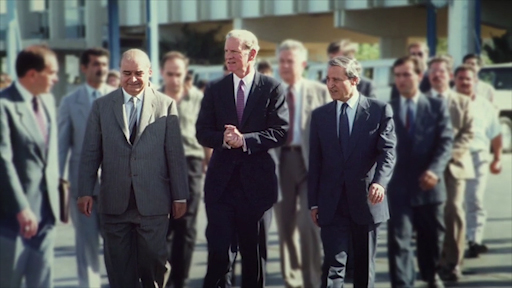
James Baker (ao centro), o secretário de Estado americano e o ministro sírio dos Negócios Estrangeiros, Farouk al-Shara (à dir.) – Damasco terá aceitado participar na Conferência de Madrid depois de, alegadamente, Washington ter prometido não se opor à continuação da sua presença militar (cerca de 40 mil soldados) no Líbano, finda a guerra civil em 1990
© jamesbaker.thinkport.org/

O omnipresente (o seu retrato está em todo o lado) e todo poderoso (os seus espiões controlam todos os movimentos) Presidente Hafez al-Assad [1930-2000], cognominado “O Leão de Damasco”, assegura que pode esperar mais 100 anos pelos Montes Golã.

Com dificuldades os sírios tentam passar a sua mensagem. Por muito que ela seja pertinente, raramente é bem recebida, em especial no Ocidente. Há uma grande necessidade neste país de técnicos de comunicação.

O estrangeiro que chega a Damasco tem para apreciar muita beleza, como os monumentos históricos dos tempos do Império Otomano ou os do Califado Omíada. Parece que se vive no passado, isolado do mundo real. A cidade tem boas estradas, prédios modernos, escolas e clínicas privadas, carros de luxo.

Mas, as comunicações telefónicas com o exterior são penosamente demoradas. Só se pode ver televisão nacional. As notícias da imprensa local são censuradas. As máquinas de fax só existem nos ministérios, as declarações das autoridades são propaganda pura.

Talvez, as autoridades de Damasco tenham de aprender com os personagens de uma lenda que se conta na área ocupada dos Montes Golã.

Narra a história que, nas horas de monotonia, os militares israelitas comunicam com os soldados sírios do outro lado do planalto servindo-se da Playboy. Abrem a revista nas páginas com fotos de mulheres nuas, e os sírios apreciam o panorama com os seus binóculos de longo alcance. Por sinais que ambos entendem, agradecem ao inimigo.

O que os separa, parece ser, sobretudo, um muro psicológico. E, por essa razão, é tão difícil de transpor.

Soldados sírios em Quneitra, a única cidade dos Montes Golã que Israel devolveu a Damasco, depois de conquistar o planalto em 1967 e de o anexar em 1981
© Middle East Eye

Este artigo, agora revisto e actualizado, foi publicado originalmente no jornal PÚBLICO em 13 Novembro 1991 | This article, now revised and updated, was originally published in the Portuguese newspaper PÚBLICO on November 13, 1991
“Não temos medo das balas deles, muito menos das suas palavras”

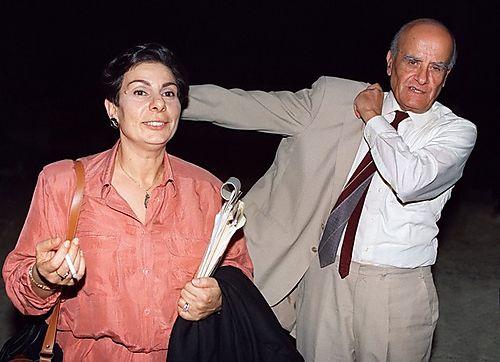
Numa passagem por Amã, depois da Conferência de Paz de Madrid, Hanan Ashrawi e Haider Abdel-Shafi falam dos desafios que os palestinianos enfrentam para que a sua luta pela independência seja reconhecida num mundo que tem sido complacente com as políticas de ocupação de Israel. (Ler Mais | Read more…)  

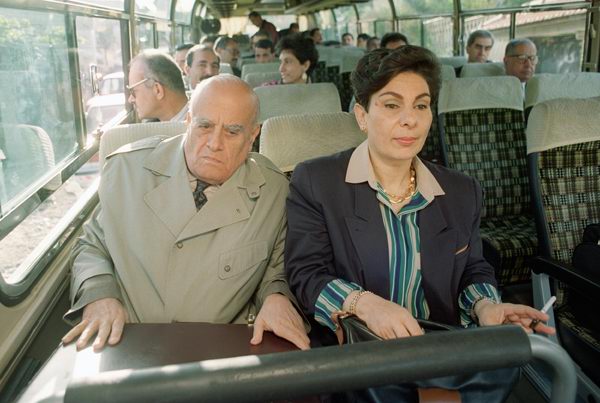
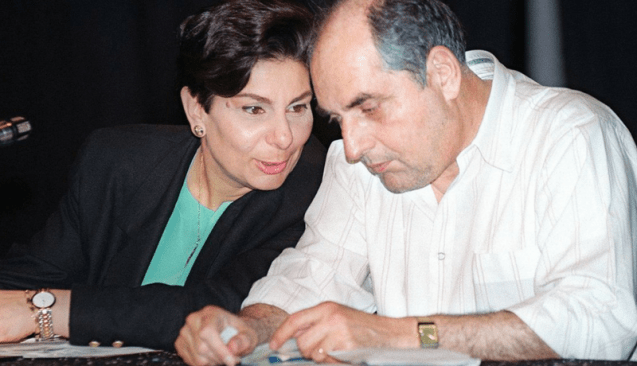
Haidar Abdel Shafi e Hanan Ashrawi, representantes dos palestinianos na Conferência de Madrid, em 1991

Os palestinianos gostariam que as conversações bilaterais com Israel se realizassem num país europeu, e que a CEE [a União Europeia/UE só foi criada em 1993] tivesse um papel mais determinante no processo de paz para o Médio Oriente.

Esta foi a mensagem transmitida por Haider Abdel-Shafi [1919-2007] e Hanan Ashrawi, respectivamente o chefe e a porta-voz da delegação palestiniana à Conferência de Madrid, num encontro realizado num Hotel de Amã, com jornalistas europeus, numa iniciativa da ONU.

Para a Hanan Ashrawi, é inadmissível que Israel, cujo comércio com a CEE representa 78% do total das suas exportações, insista em afastar a Comunidade Europeia do processo de paz.

“A CEE está em melhores condições para perceber as complexidades da região, arbitrar disputas e oferecer alternativas”, disse.

Os palestinianos conseguiram que, além dos patrocinadores da conferência (EUA e URSS), a Europa possa também ser chamada por uma das delegações para moderar. “Mas, como o convite tem de ser aceite por todos, Israel usará seguramente o seu veto”.

A professora de literatura inglesa na Universidade de Birzeit, que se tornou famosa em Madrid pelas suas contundentes conferências de imprensa, admitiu que a delegação palestiniana não está interessada em manter negociações em Washington, um dos locais que têm sido sugeridos.

Os EUA suspenderam o diálogo com a OLP e não há instituições representativas dos palestinianos na capital federal americana.

As conversações poderão iniciar-se no próximo dia 20 [de Novembro de 1991], três dias depois de o secretário de Estado americano, James Baker, regressar da sua viagem ao Extremo Oriente.

“Preferíamos um país europeu, um território neutral. Mas, é claro, Israel não quer. Eles (israelitas) protestaram veementemente contra Madrid. No entanto, Madrid está cheio de boas recordações. Tem uma tradição cristã, judaica e muçulmana”, disse Hanan Ashrawi.

Seja qual for a cidade, a delegação palestiniana solicitou aos compatriotas garantias de que os seus membros, à chegada a Jerusalém, não serão revistados, detidos ou interrogados pelas autoridades israelitas.

“Queremos ser tratados como iguais. Não pedimos favores. Para nós, é muito difícil obter vistos, documentos, licenças. Os nossos movimentos são controlados e recebemos ameaças de morte”.

Hanan Ashrawi e Faisal Husseini, da delegação palestiniana (conjunta com a jordana, por imposição de Israel), num encontro com o presidente dos EUA, George H. W. Bush, em Dezembro de 1992, na Casa Branca, em Washington
©The Times of Israel

E os representantes palestinianos levaram as ameaças muito a sério. O hotel onde ficaram instalados, no centro de Amã, estava rodeado de rígidas medidas de segurança. Na sala onde nos recebeu, três corpulentos guarda-costas vigiavam portas, corredores e elevadores, atentos a todos os movimentos dos visitantes.

Os colonatos judaicos nos territórios ocupados são um “assunto premente”. A sua suspensão não é uma condição prévia, mas Israel tem de mostrar que está interessado em avançar.

“Como é que se pode entrar num processo de negociação, quando se está a violar a essência da negociação”, interrogou a porta-voz palestiniana.

Mais calmo do que a impulsiva e dinâmica Hanan Ashrawi, com uma gentileza tocante, Haider Abdel-Shafi, o chefe da delegação interveio para salientar que a construção de colonatos “é uma violação da 4ª Convenção de Genebra”, que Israel continua a recusar aplicar aos territórios ocupados. “Eles estão sozinhos contra o mundo”, observou, com um sorriso triste.

Chafi [era] médico na Faixa de Gaza, admirado pelos seus compatriotas. Foi preso pelos egípcios, antigos administradores do território, por ter sido dos poucos que pertencendo ao Parlamento Comunista Árabe, aceitou a criação de dois Estados na Palestina, reconhecendo Israel. Isso não impediu, porém que ele voltasse a ser diversas vezes detido pelos israelitas.

Em Amã, ele propôs a criação de comissões de inspecção, semelhantes às enviadas pela ONU para o Iraque, para verificar no terreno que não estão a ser criados novos colonatos, confiscadas terras, construídas infra-estruturas, montadas casas novas ou ocupadas casas em zonas árabes.

“Os colonos podem ficar, mas o Estado palestiniano quer ter o seu próprio estatuto de residência, de nacionalidade”, sublinhou Ashrawi.

Hanan Ashrawi e Faisal Husseini, membros da delegação palestiniana que Israel “autorizou” a ir a Madrid – Yitzhak Shamir recusou admitir a OLP, então considerada “inimigo número um”

Em resposta a uma pergunta que lhe fiz, sobre as críticas de alguns palestinianos de que a delegação palestiniana partiu de uma posição minimalista para as negociações de paz, aceitando as fronteiras de Israel anteriores a 1967, o período de transição proposto pelos EUA e não exigido o regresso dos refugiados da guerra de 1948, Abdel Shafi esclareceu:

“Não neguei no meu discurso o direito de os refugiados palestinianos de 1948 regressarem. Invoquei mesmo a Resolução 194 da ONU; é verdade que aceitámos as fronteiras de 1967 (e não o plano de partilha da Palestina de 1947). Porque esta posição é a mais pertinente e realista neste momento e, além disso, foi aprovada pelo Conselho Nacional Palestiniano [em Argel, 1988]). Quanto ao período de transição, frisei que não aceitávamos que fosse permanente”.

Na capital jordana, os representantes palestinianos realçaram o facto de estarem em melhores condições do que as outras delegações árabes para negociar, sem traumas, com Israel.

“Conhecemos os israelitas melhor do que ninguém. Não temos medo deles. Sabemos como lidar com eles. Conhecemos os seus truques. Estamos habituados a negociar quando eles fecham as nossas escolas e universidades, quando o exército mata um dos nossos e queremos recuperar o corpo…”, disse Hanan Ashrawi.

Dando ênfase à sua declaração, rematou: “Se não temos medo de enfrentar as suas balas, também não temos medo de enfrentar as suas palavras”.

Elogiosa para com James Baker – ambos admitem uma admiração mútua – “É a pessoa mais teimosa que eu conheci em toda a minha vida”), a académica palestiniana está confiante de que os EUA não vão abandonar o processo de paz depois de terem trabalhado tanto para o lançar.

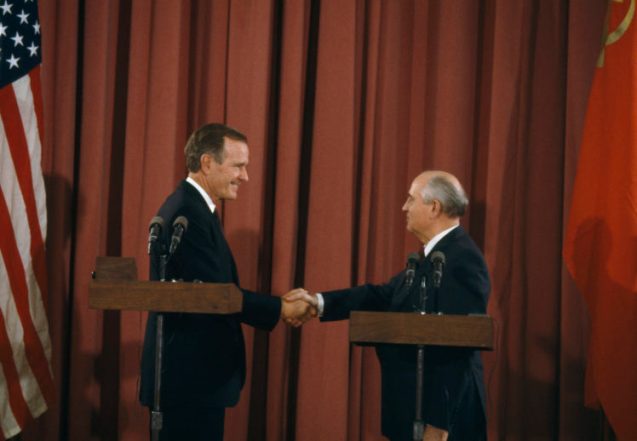
Os presidentes dos EUA, George H.W. Bush, e da União Soviética, Mikhail Gorbatchov, organizadores da Conferência de Madrid em 1991
© Pascal Le Segretain | Sygma via Getty Images

Na sua opinião, Israel deixou de ser um aliado estratégico dos EUA no novo mundo unipolar, errou ao provocar um confronto entre o Presidente Bush e o Congresso, e tem de compreender que, se quiser ter futuro no Médio Oriente, tem de deixar de ser dependente da ajuda ocidental e fazer a paz com os seus vizinhos árabes.

Perguntei a Hanan Ashrawi se a conferência de Madrid teria sido possível sem a guerra do Golfo de 1991 [que se seguiu à invasão do Kuwait, por ordem do deposto e executado ditador Saddam Hussein], e ela respondeu prontamente: “Talvez tivesse sido possível uma conferência internacional”.

“Antes da guerra, o curso dos acontecimentos já caminhava para a tragédia (fragmentação árabe, angústia crescente dos palestinianos). Depois da guerra os EUA descobriram que era necessária a estabilidade, mas que esta não era viável sem resolver a principal causa do conflito na região –o problema palestiniano”.

Hanan Ashrawi reconhece que é perigoso alimentar expectativas em relação à paz. Mas confessou que não pode deixar de se sentir entusiasmada.

Com ar fatigado, retendo a custo as lágrimas, disse: “Fomos reconhecidos, pela primeira vez, como povo […] Não há euforia, não queremos resultados instantâneos, mas queremos ver mudanças tangíveis. Não podemos negociar enquanto o povo é refém de Israel”

Segura de si, sempre com o cigarro entre os dedos, Hanan Ashrawi tornou-se uma figura extremamente popular. E tem consciência disso: “É comovente e sinto-me embaraçada, mas não me vejo como líder”.

Em Madrid, confessou ter chorado nos primeiro dias com tanta emoção. Contou que o marido, Emile Ashrawi, fotógrafo e director teatral, que a substituiu na lida da casa e na educação das duas filhas, Amal e Zeina, não teve mãos a medir com as visitas que recebia diariamente.

Achou uma ideia magnífica que jovens palestinianos, no dia da conferência tivessem decorado com ramos de oliveira os veículos dos soldados israelitas.

Mas o que mais a sensibilizou foi uma fatwa, uma espécie de édito religioso, emitida pelo xeque (líder religioso sunita) da cidade de Jenin, na Cisjordânia, autorizando que ela, “uma simples mulher”, representasse os palestinianos.

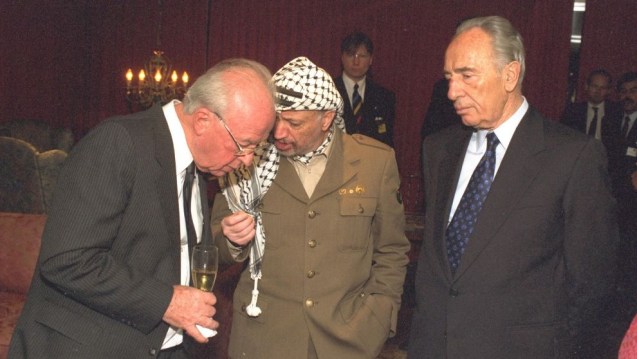
A Conferência de Madrid em 1991 iniciou um processo histórico, mas só em 1993, com a assinatura dos Acordos de Oslo, é que Israel e a OLP se reconheceriam mutuamente. (Na foto, Yitzhak Rabin, Yasser Arafat e Shimon Peres)
© The Times of Israel

Este artigo, agora revisto e actualizado, foi publicado originalmente no jornal PÚBLICO, em 9 de Novembro de 1991 | This article, now revised and updated, was originally published in the Portuguese newspaper PÚBLICO on November 9, 1991

“If we can face their bullets, we can face their words”

Hanan Ashrawi and Haider Abdel-Shafi believe that Europe is indispensable for the Middle East peace process and that Israel is going to lose its status as a strategic ally of the USA in the new unipolar world. (Read more…)

Hanan Ashrawi and Haidar Abdel-Shafi in Madrid, October 1991
© Getty Images

The Palestinians would like that the bilateral talks with Israel to be held in a European country, and that the European Economic Community [the European Union was created only in 1993] to have a more decisive role in the Middle East peace process.

That was the message given by Haider Abdel-Shafi and Hanan Ashrawi – respectively the head and the spokeswoman of the Palestinian delegation to the [October 1991] Madrid Conference – in a meeting with European journalists held in the Amman Hotel and sponsored by the United Nations.

Mrs. Ashrawi considers it inadmissible that Israel, whose trade with the European Community amounts to 78% of its total exports [The EU is sill the first partner for Israel with total trade amounting to approximately €29.4 billion in 2011] should insist on warding off the EEC from the peace process.“

The European Community is in a better position to understand the complexities of the region, to arbitrate disputes and to offer alternatives”, she said.

The Palestinians will take steps to ensure that, in addition to the sponsors of the Conference (the USA and USSR), Europe can also be called upon by one of the delegations to moderate. “But, since the invitations has to be accepted by all, Israel will certainly use its veto”, Mrs. Ashrawi added.

An English Literature Professor in Birzeit University [she founded the department in 1973 and remained a faculty member until 1995], in occupied-West Bank, who became famous in Madrid for her stunning press conferences, Hanan Ashrawi conceded that the Palestinian delegation was not interested in holding negotiations in Washington, one of the sites suggested.

The United States suspended the dialogue with the PLO, in 1990, and there are no institutions representing the Palestinians in the capital of the United States. The talks may be started on 20 November [1991], three days after American Secretary of State James Baker returns from a Far East visit.

“We would prefer a European country, a neutral territory; but Israel clearly does not want that”, said Mrs. Ashrawi. “The Israelis strongly protested against Madrid. In the meantime, Madrid is fill of good mementos. It has a Jewish, Christian and Muslim traditions.”

Palestinian delegates Hanan Ashrawi (R) and Faisal Husseini attend the 1991 Madrid Peace Conference (October 30): it was the first time that Israel, Syria, Lebanon, Jordan, and the Palestinians all came together for negotiations
© Pascal Le Segretain | Sygma | Corbis

Irrespective of the city, the Palestinian delegation asked for guarantees that its members, on arriving in Jerusalem, would not be inspected, detained or interrogated by the Israeli authorities.

“We want to be treated as equals”, Hanan Ashrawi underlined. “”We are not asking for favors. It is very difficult for us to obtain visas, documents and permits. Our movements are scrutinized and we receive death threats.”

The Palestinian representatives have taken the threats seriously. The hotel where they were logged, in the center of Amman, was under a tight security apparatus. In the room where we the meeting with the journalists was held three hefty bodyguards were monitoring doors, corridors and elevators, checking every movement of the visitors.

The Jewish settlements in the occupied territories are “an urgent matter”. Freezing their construction/expansion is not a precondition, but Israel has to show that it is interested in making progress. “How can one initiate a negotiation process when the negotiation’s essence is being violated?, the Palestinian spokeswoman asked.

More calm than impulsive and dynamic Hanan Ashrawi, and expressing with touching politeness, Haider Abdel-Shafi, head of the Palestinian delegation, intervened to emphasize that the settlement’s enterprise “is a violation of the Fourth Geneva Convention”, which Israel steadfastly refuses to apply. “They [Israelis] are alone against the world”, he remarked with a sad smile.

Abdel-Shafi is a doctor from the Gaza Strip, admired by his compatriots. He was imprisoned by the Egyptians, former administrators of the territory, for having been one of the few belonging to the Arab Communist Party.

He also accepted a two States solution in Palestine, but that did not prevent him from being taken prisoner, several times, by the Israelis authorities.

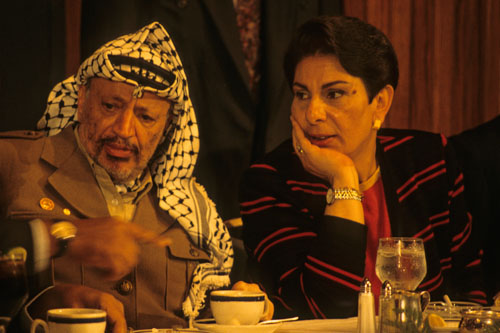
Israel objected to the PLO participation in the Madrid Conference, but Hanan Ashrawi and other Palestinian delegates could not act without previous consent from Yasser Arafat (both in this 1991 photo). @All Rights Reserved

Israel objected to the PLO participation in the Madrid Conference, but Hanan Ashrawi and other Palestinian delegates could not act without previous consent from Yasser Arafat 

In Amman, the Gaza doctor proposed the establishment of inspection commissions, similar to those sent to Iraq by the United Nations, in order to verify on the spot that new settlements are not built, that lands are not confiscated, that infrastructures are not being installed, and that new or occupied houses are not being erected in Arab zones.

“The settlers may remain, but the Palestinian state wishes to have its own statute of residence and nationality”, remarked Hanan Ashrawi.

Answering a question posed by me concerning criticism of some Palestinians that the Palestinian delegation was starting off from a minimal position for the negotiations, accepting the boundaries of Israel prior to 1967 and the transitional period proposed by the United Nations, and not demanding the return of the 1948 war refugees, Abdel-Shafi explained:

“In my speech I did not deny the right of return of the Palestinian refugees of 1948. I invoked UN resolution 194. It is true that we accepted the 1967 borders [and not the Palestine partition plan of 1947], because this position is the most relevant and realistic at this time, and it was approved by the Palestinian National Council [in Algiers, in 1988]. Regarding the transitional period, I highlighted our objection that it should be permanent.

The Palestinian representatives also stressed the fact that they were in better condition than other Arab delegations for negotiating with Israel without any trauma.

“We know the Israelis better than anyone”, said Mrs. Ashrawi, who was born in Nablus, daughter of  Daoud Mikhail, one of the founders of PLO.

“We are not afraid of them. We know how to struggle with them. We know their tricks. We are used to negotiate when they close our schools and universities, when the Army kills one of our people and we want to retrieve the body. If we are nor afraid to face their bullets, we are also not afraid to face their words.”

Full of praise for James Baker – both recognize their mutual admiration (“He is the most persistent person that I have ever met”) – Hanan Ashrawi shows confidence that the United States is not going to abandon the peace process after having worked so much to promote it.

In her opinion, Israel has ceased to be a US strategic ally in a new unipolar world, and it made a mistake by provoking a confrontation between President [George H.W.] Bush and the American Congress. Israel, she added, must understand that, if it wishes to have a future in the Middle East, it has to stop being dependent on aid from the West and to make peace with the Arab neighbors.

Haidar Abdel-Shafi's speech in Madrid: "(...We, the people of Palestine, stand before you in the fullness of our pain, our pride, and our anticipation, for we have long harbored a yearning for peace and a dream of justice and freedom. For too long the Palestinian people have gone unheeded, silenced, and denied our identity negated by political expediency, our rightful struggle against injustice maligned, and our present existence subsumed by the past tragedy of another people. Your Excellencies, ladies and gentlemen, for the greater part of this century, we have been victimized by the myth of "a land without a people," and described with impunity as "the invisible Palestinians." Before such willful blindness, we refused to disappear or to accept a distorted identity. Our Intifada is a testimony to our perseverance and resilience, waged in a just struggle to regain our rights. It is time for us to narrate our own story, to stand witness as advocates of a truth which has long lain buried in the consciousness and conscience of the world. We do not stand before you as supplicants, but rather as the torch bearers who know that in our world of today, ignorance can never be an excuse. We seek neither an admission of guilt after the fact, nor vengeance for past iniquities, but rather an act of will that would make a just peace a reality. We speak out, ladies and gentlemen, from the full conviction of the rightness of our cause, the verity of our history, and the depth of our commitment. Therein lies the strength of the Palestinian people today, for we have scaled the walls of fear and reticence and we wish to speak out with the courage and integrity that our narrative and history deserve. (...)" @All Rights Reserved

Haidar Abdel-Shafi‘s speech in Madrid:
(…) We, the people of Palestine, stand before you in the fullness of our pain, our pride, and our anticipation, for we have long harbored a yearning for peace and a dream of justice and freedom. For too long the Palestinian people have gone unheeded, silenced, and denied our identity negated by political expediency, our rightful struggle against injustice maligned, and our present existence subsumed by the past tragedy of another people. (…) For the greater part of this century, we have been victimized by the myth of “a land without a people,” and described with impunity as “the invisible Palestinians.” Before such willful blindness, we refused to disappear or to accept a distorted identity. Our Intifada is a testimony to our perseverance and resilience, waged in a just struggle to regain our rights.
It is time for us to narrate our own story, to stand witness as advocates of a truth which has long lain buried in the consciousness and conscience of the world. We do not stand before you as supplicants, but rather as the torch bearers who know that in our world of today, ignorance can never be an excuse. We seek neither an admission of guilt after the fact, nor vengeance for past iniquities, but rather an act of will that would make a just peace a reality. We speak out, ladies and gentlemen, from the full conviction of the rightness of our cause, the verity of our history, and the depth of our commitment. Therein lies the strength of the Palestinian people today, for we have scaled the walls of fear and reticence and we wish to speak out with the courage and integrity that our narrative and history deserve. (…)

I asked Professor Ashrawi whether the Madrid Conference would have been possible without the Gulf War [an American decision after Iraq invaded Kuwait in 1990; the PLO lost support from the Arab states due to Yasser Arafat’s support for Saddam Hussein’s misadventure], and she replied: “Perhaps an international conference would have been possible.”

“Before the war, the course of events was already heading for the tragedy (Arab divisions; growing anxiety of the Palestinians)”, she said. “After the war, the United States came to the conclusion that stability was necessary, but that it was not viable unless the main cause of the conflict in the region – the Palestinian problem – was not solved.”

Hanan Ashrawi acknowledged that it is dangerous to cherish hopes for peace. But she confessed that she could not stop feeling enthusiastic. Looking tired and holding back her tears, she added: “We are recognized for the first time as a people.”

“That is no euphoria. Were are not looking for immediate results, but we want to see tangible changes. We cannot negotiate so long as our people are held hostage by Israel.”

Self-assured, always holding a cigarette, Hanan Ashrawi became a very popular figure – and she is aware of it. “It is touching and I feel embarrassed, but I do not see myself as a leader.”

In Madrid, she confessed having wept with great emotion in the first days. She told me that her husband,  Emil Ashrawi, a Christian like her, photographer and theatre director, who had replaced her in the household chores and in educating their two daughters (Amal and Zeina), had been unable to cope with all the visits that he received every day.

He had hit upon a great idea that, on the day of Madrid Conference, young Palestinians should decorate the Israeli soldiers’ vehicles with olive branches.

Nevertheless, what moved her most was a fatwa, a kind of theological edit, by a Jenin Sheikh (Muslim religious leader), on the West Bank, who authorised her – a woman and a Christian – to represent the Palestinians. “I’m a simple person”, she finally realized..

Then president George HW Bush at a joint news conference with his Soviet counterpart Mikhail Gorbachev in Madrid in 1991
© Associated Press

This article, now revised and updated, was originally published in the Portuguese newspaper PÚBLICO on November 9, 1991 – the translation, slightly changed here, was published in a UN special edition called “Peace in the News”

Hussein bin Talal: “É possível uma confederação Jordânia-Palestina”

Durante cerca de uma hora de conversa, na presença da rainha Noor e de alguns colaboradores, o monarca hashemita não excluiu uma união de Estados nas duas margens do rio Jordão; confessou ter a esperança de um dia discursar num Parlamento Árabe com a estrutura do Europeu, e assegurou que o seu país já escolheu a via da democracia e do pluralismo. (Ler mais | Read more…)

A voz quase hermética de Hussein bin Talal revelou uma certa comoção, quando afirmou: “Alguns líderes [árabes] subestimam o seu povo […] talvez haja um fosso de gerações a separá-los. Foi, por isso, que nós, na Jordânia, tivemos de nos dirigir directamente ao povo”.

Foi uma espécie de autocrítica e, simultaneamente, uma tentativa para despertar consciências adormecidas entre os dirigentes árabes, esta “confissão” feita numa audiência, no Palácio Real de Amã, com vários jornalistas europeus convidados pelas Nações Unidas para uma missão no Médio Oriente.

Numa intervenção centrada no processo de democratização na Jordânia e nas negociações israelo-árabes, o monarca hashemita revelou uma enorme flexibilidade sem no entanto, ser demasiado explícito.

“Enveredámos pelo caminho da democracia e do pluralismo, mas o nosso projecto de reformas só podia começar depois de nos desvincularmos da Cisjordânia” (ao cortar relações, em 1988, com a Margem Ocidental do Jordão ocupada por Israel, Amã desistiu formalmente da soberania sobre este território, a favor dos palestinianos).

Procurando uma explicação para a lentidão do processo democrático, o rei garantiu: “Não podíamos ter realizado eleições antes. Mas, começámos a pôr a nossa casa em ordem, e estamos orgulhosos do que já fizemos”.

Embora Hussein tenha apontado o Parlamento jordano como um exemplo para outros países árabes, teve de admitir que alguns deputados e membros do seu Governo se opuseram ao processo de paz.

“Algumas pessoas tiveram dificuldade em ajustar-se, mas a maioria esmagadora [dos jordanos] é a favor [das negociações de paz]. Continua a haver o perigo de extremistas de ambos os lados se unirem”.

Para impedir que uma estranha aliança entre a Irmandade Muçulmana e o bloco comunista boicotassem a Conferência de Madrid, o rei usou, em Outubro [de 1991], os seus poderes constitucionais para adiar a abertura do Parlamento por uns dias.

Confiante de que a crise entre os parlamentares e o Governo dirigido pelo palestiniano Taher al-Masri será resolvido a tempo (o primeiro-ministro tem mantido diariamente contactos com os blocos que exigiram a sua demissão), Hussein assegurou: “ Vou abrir o Parlamento no próximo dia 1 de Dezembro”.

Humilde, o Rei jordano confessou que se sentiu emocionado ao discursar recentemente no Parlamento Europeu. E exprimiu um desejo: “Espero poder um dia discursar num Parlamento árabe, com uma estrutura semelhante”.

© collections.tepapa.govt.nz

Orgulhoso dos planos empreendidos para instaurar a democracia na Jordânia (“ Vamos realizar eleições livres!” –prometeu), o soberano considerou, por outro lado, que a paz na região será a maior conquista de todos os seus anos de reinado.

“Algumas pessoas mantêm as suas visões limitadas (…), por isso, há perigos para o processo de paz, mas também uma grande esperança”. Sobre uma eventual confederação jordano-palestiniana, o rei disse: “ As pessoas poderão escolher livremente, e nós estamos a avançar para uma fase em que isso será possível”.

Num anterior encontro, Adel Irsheid, responsável pelo Departamento de Assuntos Palestinianos do Ministério jordano dos Negócios Estrangeiros, mostrara-se convencido de que um dos resultados das negociações de paz será, seguramente, uma confederação  jordano-palestiniana, ainda não totalmente delineada.

A Jordânia e a OLP assinaram este ano [de 1991] um acordo político que prevê laços confederais entre ambas as partes nos territórios ocupados por Israel.

Um acordo semelhante celebrado pelo rei Hussein e por Yasser Arafat, em 1989, nunca se materializou, devido às pressões exercidas por algumas facções “radicas” palestinianas sobre o líder da OLP. Desta vez, foram os chamados “moderados” que o forçaram a avançar, em vez de recuar.

Quando perguntei a Irsheid se Israel poderia ser incluído numa futura confederação jordano-palestiniana, ele sorriu maliciosamente e respondeu: “Não haverá lugar. É impossível”.

O Rei Hussein não fechou totalmente a porta. “Só temos falado seriamente de uma confederação jordano-palestiniana. Para além disso, não sei. É muito cedo para discutir este assunto [inclusão de Israel]. As pessoas podem ter diferentes pontos de vista”.

© AFP | East News

O direito de os refugiados palestinianos de regressarem à sua pátria ou serem indemnizados, conforme estipulam as resoluções da ONU, deve ser respeitado, na opinião de Hussein e na de Irsheid.

Mais específico do que o monarca, Irsheid, ele próprio um palestiniano, está convencido de que a maioria dos que vivem nos campos de refugiados vai querer regressar. E a Jordânia a isso os vai aconselhar. Garantiu, porém, que ninguém será forçado. Os que optarem por continuar a viver neste país, manterão a nacionalidade jordana.

Para evitar a repetição de dramas, como a fuga maciça de 300 mil palestinianos do Golfo para a Jordânia, o Rei Hussein colocou uma questão intrigante: “Os israelitas podem ter nacionalidade dupla, por exemplo, israelita e americana. Talvez, no futuro, as pessoas [mas quem?] possam ter mais do que uma nacionalidade. Seria uma maneira de criar estabilidade e segurança, sem a ameaça de perder subitamente tudo”.

Com convicção, Hussein reafirmou que a Resolução 242 da ONU continua a ser base das negociações; insistiu em que Jerusalém Oriental é para os árabes território ocupado, embora reconheça que se trata de um problema difícil de resolver (palestinianos e israelitas disputam a cidade como sua capital).

Falou da necessidade de solucionar a crise da água na região –“um enorme desafio” –, que poderá provocar a próxima guerra, e esclareceu que a segurança de Israel é algo para ser discutido, porque não pode ser traçado no terreno.

Umas vezes confiante, outras mais pessimista, Hussein advertiu que este processo será longo. “O fracasso ou a regressão representarão uma tragédia para o mundo inteiro”.

A “luz” de Hussein

Parecia  história de fadas. Enquanto o rei falava, a rainha fixava nele o seu olhar azul. E percebemos a razão do seu nome: Noor Al Hussein, a “Luz de Hussein”.

No seu fato de saia e casaco cinzento, blusa de seda branca, sapatos de salto alto e bandolete negra, segurando longos e brilhantes cabelos loiros, a rainha da Jordânia é uma mulher imponente. Recebe os seus convidados ao lado do rei, mas em segundo plano. Aperta a mão com firmeza e balbucia: Welcome (bem-vindo)!

Na sala, ela acende e apaga as luzes, dá ordens aos empregados, recebe mensagens, tudo com a maior elegância e discrição. Quando o rei está prestes a finalizar o seu discurso, ela dá-lhe ênfase, acrescentando algumas palavras.

Nota-se uma grande segurança nesta “rainha das arábias”, filha de um americano e de uma sírio-libanesa, talvez pelo facto de ser a mulher de um verdadeiro sobrevivente do volátil Médio Oriente.

Hussein subiu ao trono em 1952, por incapacidade do seu pai governar. Aos 17 anos, tornou-se o mais jovem chefe de Estado. Sobreviveu a todas as “tempestades” no deserto –tentativas de assassínio guerras e revoluções -, e tornou-se num dos estadistas há mais tempo no poder.

Tal como nas histórias infantis, também Noor e Hussein vivem num lindo palácio. O caminho para a casa real é ladeado de ciprestes, pinheiros e palmeiras e, para lá chegar, os visitantes têm de passar por três barragens, controladas por soldados de boinas verdes e encarnadas.

À entrada, não há carruagens nem coches, mas Mercedes e Jaguares. E muitos, muitos guardas. Pagens e aias também não entram nesta história, mas sim secretárias, agentes secretos e guarda-costas.

De um pequeno gabinete com objectos antigos e alguns livros sobre política e literatura, somos conduzidos à presença dos reis. É um momento solene, pelo qual esperámos cerca de seis horas.

A sala do encontro era majestosa. Um enorme móvel de madeira trabalhada em forma de arabescos, e contendo elementos em mármore e azulejo, ocupava uma das paredes de alto a baixo. Quadros com o deserto e beduínos pintados a aguarela eram uma autêntica homenagem às raízes do reino hachemita.

O retrato a óleo do Rei Abdullah I colocado a um canto estava em perfeita sintonia com o assunto em discussão –o processo de paz israelo-árabe.

O avô de Hussein foi assassinado, em 1951 por um palestinianos, acusado de ter vendido a alma aos britânicos ao aceitar alegadamente, a criação de um Estado judaico na Palestina.

Pratos com bolos, frutas e vegetais enchiam quase por completo a extensa mesa de mármore com capacidade para mais de 20 pessoas. Os visitantes tinham lugar marcado, com o seu nome inscrito num pedaço de papel branco gravado com o dourado selo real.

Quase sempre de braços cruzados, fazendo de vez em quando pequenos gestos com as mãos, o rei falava em voz baixa e quase imperceptível. O ar formal e fleumático deve-o provavelmente à sua educação britânica e à sua formação militar na Academia Real inglesa de Sandhurst.

Estes dois artigos, agora revistos e actualizados, foram publicados no jornal PÚBLICO, em 7 Novembro de 1991 | These two articles, now revised and updated, were published in the Portuguese newspaper PÚBLICO, on November 7, 1991

King Hussein: “It is possible a Jordanian-Palestinian confederation”

We waited for more than five hours and he spoke for about one hour. In a meeting with a group of journalists invited by the United Nations, the Hashemite monarch admitted for the first time a different solution for the conflict with Israel. He also hoped to speak in an Arab parliament similar to the European one. (Read more…)

PLO leader Yasser Arafat (left), Egyptian President Gamal Abdel Nasser (center) and King Hussein of Jordan 
© Getty Images

The almost inaudible voice of visionary Hussein bin Talal revealed a certain quiver when he said: “Some Arab leaders underestimate their own people… perhaps there is a generation gap that separates them. Perhaps that is why we, in Jordan, have to directly address the people.”

This “confession”, made during as interview in the royal palace of Amman, with several European journalists (I was one of them), invited by the United Nations for a mission to the Middle East, was both a kind of self-criticism and, at the same time, an apparent effort to awaken dormant consciences of the Arab leaders.

In an address centered on the democratization process in Jordan and the Israeli-Arab negotiations, the Hashemite King expressed great flexibility but without being too explicit.

“We are following the road of democracy and pluralism, but our reforms’ plan could not begin until after we have disengaged from the West Bank.” (By breaking off relations, in 1988, with the territory occupied by Israel since the 1967 war, Amman formally gave up its sovereignty ambitions in favor of the Palestinians.)

Seeking an explanation for the slowness of the democratic process, the King said: “We could not have held elections earlier; but we begin to set our house in order, and we are proud of what we have already done.”

Although Hussein singled out the Jordanian Parliament as an example for other Arab countries, he had to admit that some deputies and members of his Government objected to the peace process.

“Some people have difficulty in adjusting, but the overwhelming majority [of the Jordanians] are in favor [of the negotiations with Israel]. There remains the danger of extremists joining together on both sides.”

In order to prevent a strange alliance between the Muslim Brotherhood and the communist bloc from boycotting the [1991] Madrid Conference, the King used his constitutional powers, in October, to postpone the opening of the Parliament for a few days.

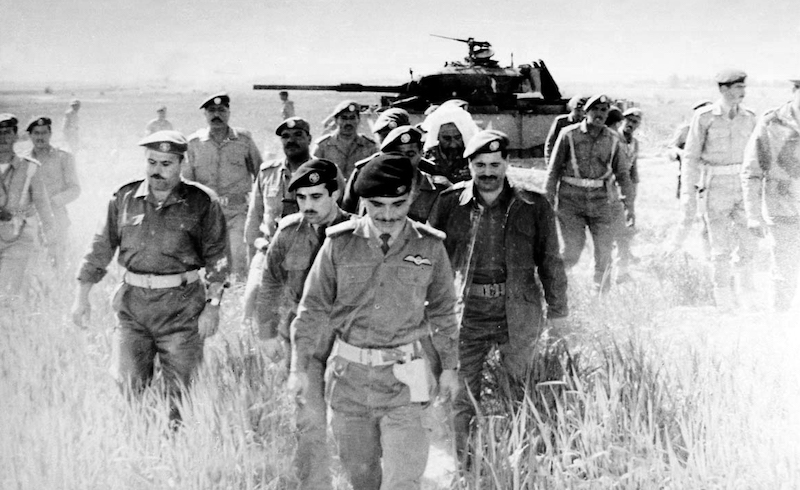
King Hussein of Jordan inspects abandoned Israeli tanks after the Battle of Karameh
© Wikimedia Commons

Confident that the crisis between the parliamentarians and the Government led by Palestinian Taher al-Masri will be solved in time (the Prime Minister has kept in touch daily with the blocs that called for his dismissal), Hussein stated: “You will open the Parliament on the 1st of December.”

[Masri lead the Government from 19 June 1991 to 21 November 1991.]

The monarch humbly confessed that he felt heartened when he spoke recently in the European Parliament. And he expressed a wish: “I hope to be able, one day, to speak in an Arab Parliament, with a similar structure.”

Proud of the plans set to establish democracy in Jordan (“We are going to have free elections!”, he promised), the King felt confident, on the other hand, that peace in the region would be the greatest victory of his entire reign. [He signed a peace treaty with Israel in 1994.]

“Some people stick to their own limited views… and there are henceforth dangers in the way of the peace process, although also a great hope”, underlined Hussein.

In what concerns an eventual Jordanian-Palestinian confederation, he clarified: “The people will be able to choose freely, and we are going to move ahead to a stage where that will be possible.”

At a previous meeting, Adel Irsheid, director of the Palestinian Affairs Department of the Jordanian Foreign Ministry, expressed his belief that one of the results of the peace negotiations would certainly be a confederation, not yet fully formed.

In 1991, the PLO and Jordan – where the around 60% of the population is from Palestinian origin – signed a political agreement stipulating confederation links between both parts in the occupied territories.

A similar agreement, signed in 1989, by Hussein and Yasser Arafat, was never applied due to the pressure exerted by some “radical” factions on the PLO leader. Hereafter it was the “pragmatics” that forced him to move ahead instead of retreating.

When I asked Irsheid about whether Israel could be included in a future Jordanian-Palestinian confederation, he replied with a wicked smile: “It will no happen; it is impossible!”

Kink Hussein did no completely close the door: “We have seriously spoken about a Jordanian-Palestinian confederation; beyond that, I do not know. It is too soon to discuss this matter [inclusion of Israel]. The people may have very different points of view.”

The Palestinian refugees right of return to their homeland or to be compensated in accordance with the provisions of United Nations resolutions must be respected, according to Hussein and Irsheid.

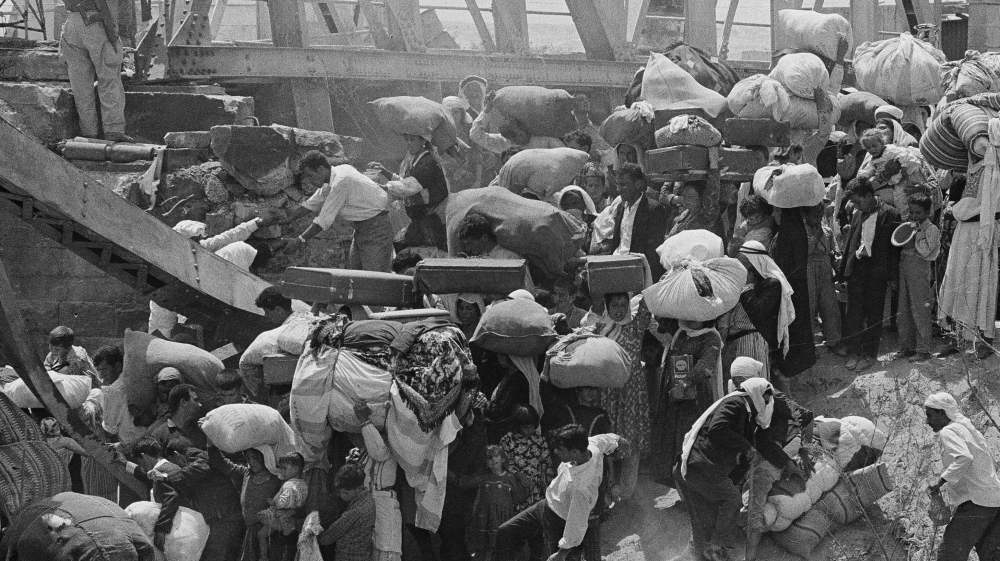
Palestinian refugees carry their belongings as they prepare to cross the wrecked Allenby Bridge over the Jordan River from the Israeli-occupied West Bank on June 22, 1967
© Associated Press

More definitely than the King, Irsheid, being a Palestinian, is convinced that the majority of those who are living in refugee camps want to go back. And Jordan is going to advise them on this problem. However, he guaranteed that no one would be forced. Those who choose to live in Jordan will retain the kingdom’s nationality.

In order to avoid a repetition of tragedies like the massive exodus of 300,000 Palestinians from the Persian Gulf [expelled after the PLO supported Saddam Hussein’s Iraq invasion of Kuwait] to Jordan, King Hussein raised an intriguing question

“The Israelis may have dual nationality, both Israeli and American, for example”, he said. “Perhaps, in the future, people (but who?) may have more than one nationality. It would be a way of creating more stability and security, without this threat of losing everything at once.”

Expressing himself in strong terms, Hussein reaffirmed that the United Nations resolution 242 is still the basis of the negotiations; he insisted that, for the Arabs, East Jerusalem is occupied territory, albeit recognising that it is a different problem to be solved (Palestinians and Israelis contend that the city is their capital).

Hussein also spoke about the need to settle the region’s water crisis – “a giant challenge” – which may lead to the next war. Afterwards, he explained that Israel’s security is something to be discussed, because it cannot be mapped on the land.

With a mixture of confidence and pessimism, Hussein warned that the peace process is going to be a long one: “Failure or retreat will be a tragedy for the whole world.”

Noor: The shining light of Hussein

It was a like a fairy tale. When the King was speaking, the Queen’s blue eyes were fixed on him. We understand now the meaning of her name: Noor al-Hussein or “Hussein’s shining light”.

In her grey outfit, with silk blouse, high-heeled shoes a black headband holding her long dazzling hair, the Queen of Jordan is a striking lady. She receives their guests at the King’s side, but close behind. She holds out her hand firmly and whispers: “Welcome.”

In the room, she switches on and turns off the lights, gives orders to the servants, receives messages – everything with the utmost elegance and discretion. When the King is coming to end his statements, she gives him emphasis by adding some words.

[Noor, who was born, in 1951, as Lisa Najeeb Halaby (she was renamed on her conversion to Islam), is the fourth wife (now widow) of Hussein. They married in Amman on 15 June 1978.]

This “Arabian Queen” Noor,  daughter of an American (father) and a Syrian-Lebanese mother, appears to the visitors as a very self-assured woman, perhaps because she is the wife of a genuine survivor of the volatile Middle East.

©royalisticism.blogspot.com


Hussein came to the throne in 1952, because his father was unable to govern, due to a mental illness. At 17-years-old, he became the youngest head of State. He survived all the “storms” in the desert – attempts to assassinate him, wars and revolutions – and managed to be one of the statesmen longest in power.

As in children’s tales, Noor and Hussein also live in a beautiful palace. The road leading to this royal house is bordered by cypresses, pines and palms – in order to reach it, visitors must pass through three barriers controller by soldiers with green and red berets.

There are no carriages or coaches at the entrance, only Mercedes and Jaguars. And there are lots, lots of guards. Neither pages nor chambermaids enter into this story; only secretaries, secret agents and bodyguards.

From a small cabinet with antique objects and some books on politics and literatures, we are accompanied up to the royal couple. It is a solemn moment, for which we waited for about six hours.

The meeting room is majestic. A huge piece of furniture carved in arabesques, inlaid with marble and tile, filled one of the walls from top to bottom. Water-colored pictures of the desert and Bedouins were an authentic tribute to the Hashemite monarchy’s roots.

The oil painting of Abudllah I, hung in a corner, was in perfect keeping with the issue under discussion – the Israeli-Arab peace process.

Hussein’s grandfather was murdered by a Palestinian, in June 1951, accused of having “sold his soul” to the British Mandate authorities, allegedly in order to establish a Jewish State in Palestine.

© Getty Images | The National

This article, now revised, was originally published in the Portuguese newspaper PÚBLICO (November 7, 1991) and in a UN special edition called “Peace in the News”

Os filhos de Abu Ammar

Em Tunes, seu quartel-general, a OLP de Yasser Arafat criou uma Casa da Resistência para acolher órfãos de combatentes palestinianos. Este é um lugar de memórias amargas e de alguma esperança. (Ler mais | Read more…)

© Donald McCullin
(The Palestinians, Jonathan Dimbleby, Quartet Books, 1979)

Jamal Ibrahim tem seis anos, mas parece ter apenas metade da sua idade real. O seu rosto é macilento. Os olhos são tristes. O seu corpo franzino tem uma ligeira deformação. Perdeu os pais em Beirute, durante um ataque a um campo de refugiados, onde viviam. Quando for grande, quer ser soldado.

Jamal é um dos 52 filhos adoptivos de Yasser Arafat, que vivem em Beit Somoud (ou Casa da Resistência) em Tunes, um lar para crianças que ficaram órfãs em resultado das várias batalhas travadas pelos palestinianos no Líbano.

Por incrível que possa parecer, a directora do orfanato diz que Arafat visita todas as semanas os seus filhos para lhes dar “afecto e carinho”.

Mas não é a figura do líder da OLP que enche as paredes das camaratas da Casa da Resistência. São páginas de revistas com os rostos de Tom Cruise ou Julia Roberts, de Rob Lowe ou Sabrina, uma cantora italiana.

Um jovem forrou o quarto com posters de cançonetistas egípcias, outro colocou em lugar visível molduras com as fotografias da namorada, outro ainda preferiu afixar um retrato grande do pai, morto em combate.

Os responsáveis pelo orfanato admitem que muitos destes jovens e crianças ficaram marcados pela guerra que domina os seus pesadelos. Talvez as estrelas de cinema e da música ajudem a tornar mais luminosos os seus sonhos.

À cabeceira dos beliches, rádios e gravadores do último modelo transmitem, em alto som, rock e rap. Ao fundo das camas, ténis de marca estão cuidadosamente alinhados junto de várias mochilas.

A arrumação dos quartos sugeria que tudo fora preparado para a visita de um grupo de jornalistas europeus, convidados pelas Nações Unidas.

© Donald McCullin
(The Palestinians, Jonathan Dimbleby, Quartet Books, 1979)

O edifício, de rés-do-chão e primeiro andar, é uma mistura de casa de família e internato: a sala de estar com televisão e sofás, os quartos com colchas às flores para as raparigas e uma decoração mais austera para os rapazes, uma clínica e um pátio para jogos.

Tudo começou em 1976, depois da destruição do campo de refugiados de Tel al-Zaaatar, no sector oriental de Beirute. Para abrigar as crianças que ficaram sem mãe e pai, as lideranças da OLP decidiram fundar a Casa da Resistência para os “órfãos dos mártires”.

Em 1982, depois da invasão israelita e do massacre de centenas de palestinianos nos campos de Sabra e Shatila, em Beirute Ocidental, a instituição, que contava com 450 crianças, foi transferida para a Síria, onde ainda funciona. No mesmo ano, as autoridades tunisinas decidiram acolher alguns destes órfãos, e doaram um edifício em Tunes para esse efeito.

O orfanato é financiado conjuntamente pela OLP e pelo Governo tunisino. São 52 crianças, dos seis aos 18 anos, e para cada grupo de sete há uma “mãe”, geralmente uma enfermeira, que os acompanha até saírem da instituição.

Aqui comem, dormem e vivem. Frequentam a escola al-Qods (Jerusalém), propriedade da OLP, e quando acabam os estudos vão trabalhar para os vários organismos ligados à central palestiniana.

Ao chegarem à idade de casar, a maioria prefere os seus companheiros de infortúnio, perpetuando a herança palestiniana. Umas 20 pessoas, entre empregados, enfermeiros, médicos e psicólogos, constituem a família dos jovens de Beit Somoud. “Tentamos compensá-los do sentimento de perda dos seus pais, da sua terra”, disse a directora do orfanato.

“Um dia, havemos de regressar à Palestina; as pessoas não serão um obstáculo”, cantou, à despedida, uma garota de 16 anos.

© Donald McCullin
(The Palestinians, Jonathan Dimbleby, Quartet Books, 1979)

Este artigo, agora revisto e actualizado, foi publicado originalmente no jornal PÚBLICO em 5 Novembro 1991 | This article, now revised and updated, was originally published in the Portuguese newspaper PÚBLICO on November 5, 1991

The sons and daughters of Abu Ammar

The House of Resistance in Tunis has been a home for orphan Palestinian children, victims of the several Lebanon wars. It was here that we met Jamal Ibrahim. (Read more…)

@Eyad Abed

© Eyad Abed

He is six-years-old but Jamal Ibrahim seems to be only half his real age. His face is haggard. His eyes are sad. His slender frame is slightly deformed. He lost his parents in Beirut during an attack on a refugee camp where they were living. When he grows up he wants to be a soldier.

Jamal is one of 52 adopted children of Yasser Arafat who live in Beit Somoud (House of Resistance) in Tunis. It is a home for Palestinians sons and daughters who became orphans as a result of the several Lebanon wars.

Incredible as it may seem, the orphanage’s director says that Abu Ammar (nom de guerre of Arafat) visits the children every week to give them “affection and love”.

It is not the picture of the PLO, though, that covers the walls of the bedrooms in the House of Resistance. Instead, there are pages from magazines showing the faces of American actors Tom Cruise, Julia Roberts and Rob Lowe, and Sabrina, an Italian singer.

One young man plastered his room with posters of Egyptian ballad singers, another fixed framed photographs of his sweetheart in a visible place. A third one has chosen to hang up a large picture of his father killed in action.

Those in charge of the orphanage admit that many of these young people and children are affected by the war that haunts their nightmares. The movie stars and top musicians may turn their dreams more pleasant.

On the bed boards of the bunks, the latest radios and recorders pour out both rock and rap at full blast. At the bottom of the bed, high-quality tennis rackets are carefully aligned next to several knapsacks.

© Misha Erwitt | NY Daily News Archive via Getty Images

The tidiness of the rooms suggests that everything was prepared for the visit of a group of European journalists (I was one of them) invited by the United Nations.

From the ground and first floors, the building is a mixture of home and boarding school. The living room with its television set and sofas; the bedrooms with their flowering coverlets for the girls and a more austere pattern for the boys; a clinic and a playground.

It all began in 1976, after the destruction of the Tel al-Zaatar refugee camp, in the eastern sector of Beirut. Between 50,000 to 60,000 people lived there. The Lebanese civil war had entered its second year. Christian militias, supported by Damascus troops, had laid siege to the for 7 months. When the camp fell, the Palestinian victims numbered almost 3,000, mostly civilians.

In order to shelter the children without parents, the PLO leaders decided to establish the Home of Resistence for the “orphans of the martyrs”.

In 1982, after the Israeli invasion and a massacre of hundreds of Palestinians in Sabra and Shatila camps of West Beirut, the institution with its 450 children was transferred to Syria, where it continues to operate [in 1991].

On August 13, after fifty-three days of unrelenting siege, the defenders of the camp let down their guard as the first Red Cross vehicles approached Tal al Zaatar with the permission of the rightists. The people of the camp believed that a final agreement between the Arab League and the International Red Cross to evacuate the camp had been reached. As the inhabitants of the camp began to leave their shelters, they saw they had been betrayed: behind the Red Cross vehicles were the rightist troops! As soldiers overran the camp, they unleashed a bloody massacre, gunning down defenseless civilians, including medical personnel. The rightists deliberately killed every Palestinian male between the ages of fourteen and forty. Before the camp was totally overwhelmed by the attackers, thousands of people were forced to flee; over two thousand people were killed. The rightists razed Tal al Zaatar to the ground. Source: Here

“On August 13, 1976 after 7 months of unrelenting siege, the defenders of Tel al-Zaatar surrendered as the first Red Cross vehicles approached the camp with the permission of the rightist militia that, supported by Syria, was responsible for the siege. The refugees believed that a final agreement between the Arab League and the International Red Cross to evacuate the camp had been reached. As they began to leave their shelters, the betrayal was evident: behind the Red Cross vehicles were militiamen. They overran the camp, unleashing a bloody massacre. Every Palestinian male between the ages of 14 and 40 were deliberately gunned down. Before the camp was totally overwhelmed by the attackers, thousands of inhabitants were forced to flee (as those in the photo). Almost 3,000 people were killed”
© Our Roots are still alive

Also in 1982, the Tunisian authorities decided to tae in some of these orphans. They donated a building in Tunis for that purpose.

The PLO and the Tunisian Government jointly finance the orphanage. There are here 52 youngsters, ranging from 6 to 18-years-old; and there is a “mother” for each group of seven, generally a nurse who looks after them until they leave. It is here that they eat, sleep and live.

The boys and girls attend the PLO-owned Al-Quds’ (Jerusalem) school. After finishing their studies they go to work at several units linked to the Palestinian center.

When they grow old enough to marry, most of them usually choose their companions of misfortune, thus perpetuating the Palestinian heritage.

Some 20 persons, including employees, female nurses, doctors and psychologists, constitute the youngsters’ family at Beit Somoud. “We try to lessen their feeling of having lost their country”, said the orphanage’s head nurse.

“Someday we will return to Palestine – people will not be an obstacle”, chanted a 16-years-old girl saying goodbye to the journalists.

@Mohammed Zaatari

© Mohammed Zaatari

This article, now revised and updated, was originally published in the Portuguese newspaper PÚBLICO (November 5, 1991) and in a UN special edition called “Peace in the News”